
Professional custom web development for bespoke business websites typically ranges from €9,000 to €50,000 in 2026. Pricing depends on complexity, agency location, and required functionality. A simple corporate site with 10–20 pages and a content management system is at the lower end. Feature-rich platforms with integrations, e-commerce, and custom workflows can exceed €50,000, reaching six figures for enterprise builds.
That's a wide range, and for good reason. Custom website costs depend on many factors, such as your development team's location and whether you want AI-driven personalisation or a simple, fast site designed to convert visitors into leads. In this guide, we'll break down:
- A quick-reference pricing table by project type and region
- The key factors that drive bespoke website development costs up (or down)
- How European regional pricing differs - and why it matters
- Freelancer vs agency: what you actually get for the money
- Hidden costs most businesses overlook until it's too late
- How to evaluate and choose a reliable custom web design agency
- 2026 trends (AI, accessibility, performance) that are reshaping pricing
What Does a Custom Website Actually Cost? A Quick-Reference Table
Before delving into the details, here is an overview of what European businesses are spending on professional web design services in 2026, derived from project data from Clutch, industry reports, and agency rate cards:
| Project Type | Complexity | Western Europe | Central & Eastern Europe |
|---|---|---|---|
| Simple informational site (5–10 pages) | Low | €5,000 – €10,000 | €2,500 – €5,000 |
| Standard business website with CMS | Medium | €10,000 – €25,000 | €4,000 – €10,000 |
| Corporate site with custom features | Medium–High | €18,000 – €45,000 | €8,000 – €20,000 |
| Custom e-commerce platform | High | €25,000 – €70,000+ | €12,000 – €35,000 |
| Enterprise web application | Very High | €50,000 – €150,000+ | €25,000 – €75,000+ |
Fast Fact: The global web development services market is valued at approximately €81 billion in 2026 and is projected to reach €124 billion by 2031, growing at 8.87% annually (Mordor Intelligence, 2026). That growth is pushing both demand and pricing upward across Europe.
These numbers outline the initial build costs only. Ongoing expenses such as hosting, maintenance, and content updates are not included; those additional costs are discussed later in this guide.
What Drives the Cost of a Custom Website?
If you’ve received two very different quotes for the same brief and wonder why, you’re not alone. Custom website cost isn’t arbitrary. It's shaped by a few key factors.
1. Scope and Functionality
This is the biggest lever. A simple ten-page corporate site with a contact form requires much less work than a complex multilingual e-commerce platform. E-commerce sites include features such as user accounts, payment processing, inventory tracking, and CRM integration. Each additional feature - such as a booking system, client portal, or interactive product configurator - adds more design, development, and testing effort.
2. Design Complexity
Bespoke website development means original design, not a tweaked template. A custom web design agency typically invests 60–100+ hours in UX research, wireframing, visual design, and responsive adaptation before writing code. If you want motion design, micro-interactions, or 3D elements - trending this year - the design phase alone may consume 25–35% of your budget.
3. Technology Stack
WordPress with a custom theme costs less than a headless CMS, which uses React for the website design and Node.js for the backend server. Choose technology based on your business needs - not what an agency prefers. More advanced setups need senior developers, who charge higher hourly rates.
4. Integrations
Connecting your website to a CRM (such as HubSpot or Salesforce), an ERP (Enterprise Resource Planning system), payment gateways, marketing automation tools, or other third-party APIs can add between €3,000 and €15,000 or more for each integration. The final cost depends on the API's reliability and the complexity of linking and translating data between systems.
5. Content and SEO
Some agencies include copywriting and on-page SEO in their quotes. Others do not. If you need professional content creation, keyword research, and technical SEO setup, add €2,000–€8,000 to your budget depending on the number of pages.
How Do Regional Pricing Differences Affect Your Budget?
Geography is arguably the second most influential pricing factor after scope. Hourly rates for web developers shift dramatically across Europe. Understanding these differences can save your business tens of thousands of euros without sacrificing quality.
| Region | Typical Hourly Rate (€) | Strengths |
|---|---|---|
| Nordic (Sweden, Norway, Finland) | €80 – €140 | Cutting-edge tech expertise, strong design culture |
| Western Europe (UK, Germany, France, NL) | €60 – €150 | Mature agencies, robust project management, local presence |
| Central & Eastern Europe (Poland, Ukraine, Czech Republic) | €25 – €60 | Strong technical talent, competitive pricing, EU-compatible hours |
| Southern Europe (Bulgaria, Romania, Serbia) | €16 – €40 | Aggressive pricing, growing talent pools |
Fast Fact: According to Forrester's 2026 forecast, Europe's total technology spending exceeded €1.5 trillion this year - a 6.3% increase - driven by AI, cloud, and digital sovereignty initiatives. Web development is a significant slice of that investment.
The hourly cost gap between Western and Eastern European agencies can be four to sixfold, but quality differences are often slight. A senior full-stack developer in Kyiv or Warsaw may charge €40–€60 per hour. One with similar skills in Berlin or Amsterdam may charge €100–€150. Both can deliver an excellent website.
This is why nearshore partnerships are so popular among European SMEs. You get timezone overlap, cultural alignment, GDPR-compliant processes, and big cost savings. At Flexi IT, we have built our model on these advantages. We deliver professional web design services to UK and European clients at rates that make sense - without cutting corners on quality or communication.
Freelancer vs Agency: What Are You Actually Paying For?
Choosing between freelancers and agencies is a common dilemma when commissioning custom web development. Here’s a realistic comparison:
| Factor | Freelancer | Agency |
|---|---|---|
| Typical cost | €3,000 – €15,000 | €10,000 – €75,000+ |
| Team composition | One person (maybe subcontractors) | Designer, developer(s), PM, QA tester |
| Project management | Informal | Structured (sprints, milestones, reporting) |
| Accountability | Individual | Institutional (contracts, SLAs) |
| Scalability | Limited | Can scale team up or down |
| Post-launch support | Variable (often minimal) | Defined SLAs, maintenance plans |
| Best for | Small, well-defined projects | Complex builds, ongoing partnerships |
Freelancers are a great choice for small, clear projects, especially if your team can handle technical management. But if you need a custom business website that performs well and grows with you, an agency offers organisation, backup, and wider skills than one person can provide.
Many growing businesses benefit most from working with a mid-sized agency - large enough to provide a cross-functional team, yet small enough to ensure your project receives dedicated attention. This is the model at Flexi IT, and it tends to deliver positive outcomes for clients.
What Hidden Costs Do Most Businesses Overlook?
The build cost is only one piece. These ongoing and extra expenses often catch clients by surprise:
- Hosting: €20–€300/month depending on traffic, server type, and whether you need managed hosting with automatic scaling.
- Domain and SSL: €15–€50/year for a standard domain. Premium domains and extended validation SSL certificates cost more.
- Maintenance and updates: Budget €100–€1,000/month for security patches, plugin updates, performance monitoring, and minor content changes. Neglecting maintenance is how websites get hacked or slowly degrade.
- GDPR compliance: Cookie consent management, privacy policy maintenance, data processing agreements. If you're handling EU customer data (and you almost certainly are), this isn't optional.
- Accessibility compliance: The European Accessibility Act (EAA) became mandatory across the EU last year. Non-compliance isn't just a legal risk - it excludes potential customers.
- Content updates: Websites aren't "set and forget." Regular blog posts, case studies, and page updates keep your site relevant for both users and search engines.
Fast Fact: Research from 2026 shows that 95.9% of websites still fail basic accessibility standards. With the EAA now enforceable, this represents both a compliance risk and a competitive opportunity for businesses that get it right.
A realistic annual maintenance budget for a professional business website sits between €2,000 and €12,000, depending on complexity. Factor this into your total cost of ownership from day one.
How Should You Evaluate a Custom Web Design Agency?
Choosing the right partner for bespoke website development is arguably more important than the budget itself. A cheap build that doesn't convert or break after six months is no bargain. Here's what to look for:
Check verified reviews, not just testimonials
Platforms like Clutch conduct phone-verified client interviews. Self-reported testimonials on an agency's own website are easy to fabricate. Look for agencies with at least 5–10 recent reviews (within the past 12 months) and pay attention to specifics: did the reviewer mention measurable outcomes, or just say "great team"?
Examine live portfolio work
Don't settle for screenshots. Visit the actual websites an agency has built. Test them on your phone. Check page speed using Google PageSpeed Insights. If an agency's portfolio sites load slowly or look broken on mobile, that tells you everything about their standards.
Ask about their process
Professional agencies follow a structured process: discovery → wireframing → design → development → testing → launch → support. If an agency can't clearly articulate its workflow, or jumps straight from "brief" to "build," that's a red flag.
Demand a written scope of work
A detailed Statement of Work (SOW) protects both parties. It should specify deliverables, timelines, revision rounds, technology choices, and what happens if scope changes mid-project. No SOW? Walk away.
Evaluate their own website
This one's underrated. If a web development agency's own site is slow, poorly designed, or hasn't been updated in two years, what does that say about the care they'll put into yours?
How Are 2026 Trends Affecting Custom Web Development Pricing?
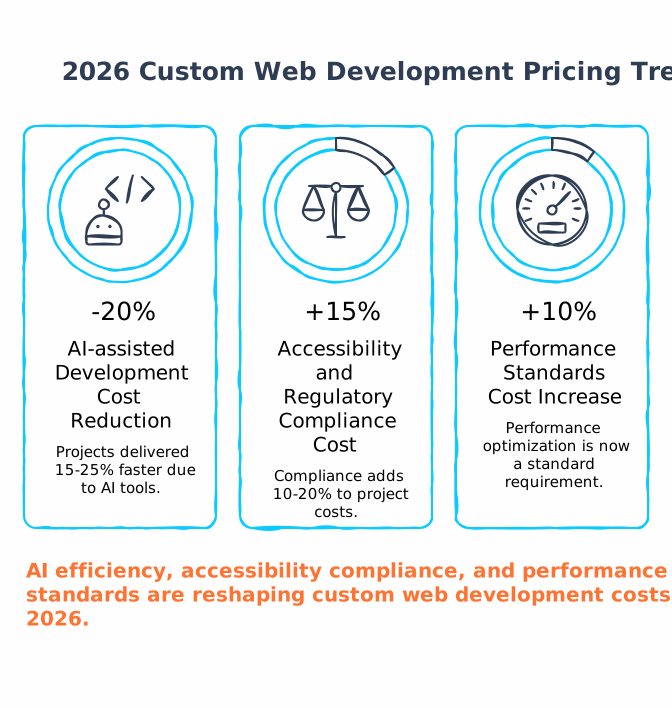
Three significant shifts are influencing what businesses pay for custom web development services this year:
AI-assisted development is reducing (some) costs
AI coding tools have matured significantly. Developers now use AI assistants for code generation, automated testing, and debugging - tasks that previously consumed hours of manual effort. This hasn't made custom development "cheap," but it has made experienced developers more productive. The result? Some agencies are delivering projects 15–25% faster than they could two years ago, and those efficiency gains are starting to show up in pricing.
That said, AI hasn't replaced the need for senior architects and UX designers. It's accelerated the mechanical parts of development while making strategic thinking and design quality even more valuable.
Accessibility and regulatory compliance add scope
The European Accessibility Act and the EU AI Act (fully applicable from August 2026) are adding new requirements to every serious web project. WCAG 2.1 Level AA compliance, proper consent management, and AI transparency obligations all require additional design consideration, development effort, and testing. Expect compliance-related work to add 10–20% to project costs compared to a few years ago.
Performance standards are non-negotiable
Google's Core Web Vitals - measuring loading speed, visual stability, and interactivity - directly affect search rankings. A beautifully designed website that scores poorly on Largest Contentful Paint or Interaction to Next Paint will struggle to rank. Performance optimisation is no longer a nice-to-have; it's baked into every competent agency's development process. And doing it properly takes time.
Key Terms
| Term | Definition |
|---|---|
| Bespoke Website Development | Building a website from scratch with custom design and functionality tailored to a specific business, as opposed to using pre-made templates. |
| CMS (Content Management System) | Software (e.g., WordPress, Drupal) that lets non-technical users manage website content without editing code. |
| Core Web Vitals | Google's set of metrics measuring page loading speed (LCP), visual stability (CLS), and interactivity (INP). They directly influence search rankings. |
| Headless CMS | A CMS that manages content separately from the front-end presentation layer, giving developers more flexibility in how content is displayed. |
| SLA (Service Level Agreement) | A formal commitment specifying response times and resolution targets for support requests after a website launches. |
| WCAG (Web Content Accessibility Guidelines) | International standards for making web content accessible to people with disabilities. Level AA is the standard compliance target in Europe. |
| SOW (Statement of Work) | A detailed project document outlining scope, deliverables, timelines, and responsibilities for both client and agency. |
Summary: What a Busy Decision-Maker Needs to Know
- Budget range: A professional bespoke business website typically costs €9,000–€50,000 with a reputable agency. Enterprise builds exceed €100,000.
- Biggest cost driver: Scope and functionality. More features, more integrations, more pages = higher cost. Define your requirements clearly before requesting quotes.
- Regional arbitrage is real: Central and Eastern European agencies deliver comparable quality to Western European firms at 40–60% lower cost, with compatible time zones and GDPR compliance.
- Don't forget ongoing costs: Hosting, maintenance, and compliance add €2,000–€12,000/year to your total cost of ownership.
- Verify before you commit: Use Clutch or DesignRush for verified reviews. Check live portfolio sites. Demand a written SOW.
- 2026 trends matter: AI is making development faster, but accessibility regulations and performance standards are adding new requirements - and costs.
- Cheapest isn't best: Agencies quoting under €5,000 for a custom business website are almost certainly cutting essential phases. You'll pay for it later in bugs, poor performance, or a rebuild.
Ready to Get a Realistic Quote?
At Flexi IT, we specialise in custom web development services for European businesses that need more than a template but don't want to overpay for a big-agency markup. We're transparent about pricing, rigorous about process, and genuinely invested in building websites that perform - not just look pretty in a portfolio.
If you're planning a bespoke website project and want a straight answer on what it'll cost, get in touch with our team. We'll give you an honest estimate based on your actual requirements - no sales theatre required.


