
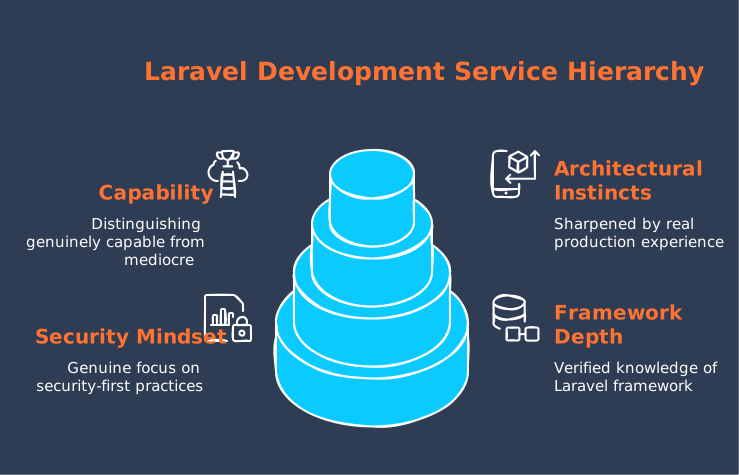
Short answer: the ones with verified framework depth, a genuine security-first mindset, and architectural instincts sharpened by real production experience. You'll typically find them in the official Laravel Partners directory, well-reviewed agencies on Clutch.co, or specialist European outfits like Flexi IT, which pair deep Laravel knowledge with proper data-protection awareness. But here's the thing - the harder question isn't which services exist. It's sorting the genuinely capable from the merely competent.
Here's what we'll walk through:
- What separates a competent Laravel development agency from a mediocre one
- Where to find reputable Laravel development services in 2026
- The security practices your Laravel partner must implement
- Architecture decisions that determine whether your app actually scales
- Realistic costs across different project types and regions
- Red flags to watch for before signing any contract
Why Laravel Remains the Framework of Choice in 2026
Worth establishing context first. Laravel now powers north of 1.7 million active websites worldwide and holds roughly 35.87% of the PHP framework market - comfortably more than double what Symfony commands. That's not a niche tool. That's an industry standard.
Fast Fact: According to the JetBrains State of PHP 2025 survey, Laravel holds 64% usage among PHP developers, making it the most widely adopted PHP framework by a significant margin.
Last February, Laravel 12 landed as the first major release with zero breaking changes. That mattered enormously - it signalled a framework confident enough in its own architecture to ship big features without pulling the rug from under existing applications. Laravel 13 drops later this month, bringing native PHP Attributes support and sharper cache optimisation, among other things. The ecosystem isn't standing still.
What does this mean practically? A massive talent pool, for starters. A stable upgrade path that won't force expensive rewrites every year. And a framework backed by active, well-funded development - not a side project someone maintains in their spare time. Good foundations, all of it. But frameworks don't build products. People do.
What Should You Look for in a Laravel Development Agency?
Deep Framework Expertise (Not Just "We Know PHP")
Scaffolding a Laravel project takes minutes. Any developer with a terminal can manage it. Knowing how to optimise Eloquent queries under genuine load, implement multi-tenancy without creating a maintenance nightmare, or design a service layer that still makes sense eight months from now - that's an entirely different conversation.
When you're sizing up a Laravel development company, get specific:
- How do they handle N+1 query problems in Eloquent?
- What's their approach to managing complex business logic - repositories, services, or actions?
- Do they use Laravel's first-party tools (Forge, Vapour, Horizon, Nova) or roll their own?
- Are they up to date with Laravel 12's simplified application structure and the upcoming Laravel 13 features?
The ones who light up when discussing these subjects? They're invested. The ones who dodge specifics and retreat into marketing language are probably staffing generic PHP developers and slapping a "Laravel specialist" label on the invoice.
Proven Delivery Methodology
Scope creep kills projects. It's unglamorous and entirely preventable, yet it remains the single most reliable way to blow a budget and miss a deadline at the same time. Any credible Laravel application development company runs a defined process - Scrum, Kanban, a pragmatic hybrid - with clear sprint cadences, explicit change-control mechanisms, and regular client check-ins. Pin them down on specifics: sprint length, how they absorb mid-flight scope shifts, and which tools they rely on for tracking and collaboration.
Where to Find Reputable Laravel Development Services
Three channels reliably surface strong providers, each suited to a different stage of your search:
| Source | Best For | What You Get |
|---|---|---|
| Official Laravel Partners Directory | Verified, high-expertise agencies | Direct access to firms vetted by the Laravel core team; 50+ partners globally |
| Clutch.co / DesignRush | Comparing agencies by reviews & budget | Verified client feedback, filtering by region, hourly rate, and minimum project size |
| Specialist agencies (e.g., Flexi IT) | European businesses needing hands-on collaboration | Direct team access, GDPR-aware development, flexible engagement models |
Start with the official directory. It's the most authoritative source available - partners there receive early security patches, maintain direct lines to the core team, and have survived a vetting process that weeds out casual entrants. Notable European-listed names include Agiledrop (EU), Jump24 (UK), and Redberry (Georgia).
Need a freelancer for a contained task? Platforms like Toptal curate seriously vetted talent pools - they report an average client rating of 4.9/5.0 across more than 5,500 reviews. Impressive numbers. But for anything production-critical that demands architectural thinking and long-term support, a dedicated agency almost always makes more sense than a solo contractor, however talented.
Security: What Your Laravel Partner Must Get Right
Out of the box, Laravel handles the basics well. SQL injection protection, CSRF tokens, XSS defences - the framework shoulders a fair share of the security burden. The problem? Applications still get compromised. Not because Laravel is weak, but because developers get careless with the details, cut corners under deadline pressure, or simply lack the experience to implement the framework's protections properly.
Here's what you should insist on from any Laravel software development partner:
- Environment variable management: Committing
.envfiles to version control remains the single most common Laravel security breach in 2026. Your partner should have ironclad practices around secrets management. - Authentication implementation: They should use Laravel Sanctum or Passport for API authentication, with multi-factor authentication as standard for sensitive applications.
- Input validation and sanitisation: Every endpoint - web and API - must validate and sanitise user input. No exceptions.
- GDPR compliance readiness: European businesses operate under GDPR (and UK GDPR post-Brexit). Your partner must understand data residency requirements and architect accordingly.
Fast Fact: Laravel Cloud achieved SOC 2 Type 2 certification in July 2025, with ISO 27001 and HIPAA compliance on the roadmap - a clear signal that the ecosystem takes enterprise security seriously.
We don't bolt security on at the end at Flexi IT. It runs through every sprint, every code review, every deployment pipeline. Treating it as a final checkbox is how breaches happen.
Scalability: The Architecture Decisions That Actually Matter
Let's be direct. "Scalable" doesn't mean "survives more traffic once you panic-buy extra servers." Genuine scalability means your application's architecture allows you to add capacity cleanly and predictably, without the cost curve going exponential. That distinction matters. Here's what separates thoughtful Laravel web development from the throw-it-at-the-wall variety:
- Database query optimisation: Proper indexing, eager loading, and query caching from day one - not as a panic fix when the app slows to a crawl.
- Queue-driven architecture: Heavy operations (email sending, report generation, third-party API calls) should run through Laravel's queue system, keeping your user-facing responses fast.
- Horizontal scaling readiness: Stateless application design, externalised sessions (Redis or database), and containerised deployments that allow spinning up additional instances without code changes.
- API-first design: If there's any chance you'll need a mobile app, a partner integration, or a headless frontend in the future, your backend should expose clean, versioned APIs from the start.
Press prospective partners on this. Ask for case studies - specific ones, with numbers. Anyone who tosses around phrases like "cloud-ready architecture" without explaining what that actually means for your application is waving a red flag.
How Much Do Laravel Development Services Cost in 2026?
Pricing swings wildly depending on where your team sits, what you're building, and how you structure the engagement. Cheap isn't always bad; expensive isn't always good. But the numbers below reflect what we see consistently across the European market right now:
Hourly Rates by Region
| Region | Junior (0–2 yrs) | Mid-Level (2–5 yrs) | Senior (5+ yrs) |
|---|---|---|---|
| Western Europe (UK, DE, NL) | €40–€60 | €70–€100 | €100–€150 |
| Eastern Europe (PL, UA, RO) | €20–€35 | €35–€60 | €60–€80 |
| South Asia (IN, PK) | €10–€20 | €20–€35 | €35–€55 |
Project Cost Ranges
| Project Type | Estimated Cost | Typical Timeline |
|---|---|---|
| MVP / Proof of Concept | €6,000–€25,000 | 4–10 weeks |
| Mid-scale web application | €20,000–€50,000 | 3–6 months |
| SaaS platform (multi-tenant) | €40,000–€150,000 | 6–12 months |
| Enterprise system | €80,000–€200,000+ | 9–18 months |
For European businesses specifically, Eastern European agencies tend to hit the sweet spot - and that includes our own team at Flexi IT. You get competitive rates, time zones that actually overlap with yours, developers who understand GDPR without needing a tutorial, and senior-level engineers who'd cost you double or triple in London or Amsterdam. It's not about finding the cheapest option. It's about finding the best return on every euro you spend.
Red Flags When Choosing a Laravel Development Company
Some warning signs are subtle. Others aren't. Keep your eyes open for these:
- Vague proposals: If the proposal doesn't specify technology stack, architecture approach, or testing strategy, walk away.
- No security discussion: Any agency that doesn't proactively raise security during the discovery phase isn't taking your project seriously.
- Unusually low quotes: If it sounds too cheap, it probably involves junior developers working without senior oversight. You'll pay for it later in the form of bugs and technical debt.
- No code ownership clause: Ensure your contract explicitly grants you full ownership of all source code and intellectual property.
- Zero testing culture: Ask about their test coverage targets. If they don't write tests - or worse, don't understand why you're asking - that's a deal-breaker.
Key Terms
| Term | Definition |
|---|---|
| Eloquent ORM | Laravel's built-in object-relational mapper for interacting with databases using PHP syntax rather than raw SQL |
| Multi-tenancy | An architecture where a single application instance serves multiple clients (tenants), each with isolated data |
| CSRF | Cross-Site Request Forgery - an attack that tricks users into performing unintended actions on a web application |
| SOC 2 Type 2 | A security compliance certification verifying that an organisation's controls are effective over a sustained period |
| Sanctum / Passport | Laravel's official packages for API token authentication (Sanctum for SPAs; Passport for full OAuth2) |
Summary for Busy Decision-Makers
- Start your search with the official Laravel Partners directory, Clutch.co, or specialist European agencies like Flexi IT.
- Prioritise security expertise - ask about environment variable management, authentication implementation, and GDPR compliance.
- Demand architectural specifics - query optimisation, queue-driven design, and horizontal scaling readiness separate good partners from average ones.
- Budget realistically: expect €20,000–€50,000 for a mid-scale app, €40,000–€150,000+ for a SaaS platform.
- Eastern European agencies offer the best value-to-quality ratio for European businesses - competitive rates with overlapping time zones.
- Avoid vague proposals, missing security discussions, and partners who can't articulate their testing strategy.
- Laravel's ecosystem is thriving - with 1.7M+ websites, 64% developer adoption, and Laravel 13 arriving this month, you're building on solid ground.


