
Short answer? A good AI integration company wires your existing tools together and gets automations running within 3–12 weeks. Sometimes faster. Agencies like Flexi IT, Softblues, and ML6 take the full-service route - they audit your systems, architect the data pipelines, and deploy AI-driven automations end to end. Platforms like Make and n8n, on the other hand, hand you the controls directly and let you stitch simpler workflows together in days, occasionally hours. The real question isn't "which tool is best?" but rather "how tangled is my particular problem?" Simple trigger-action logic? Grab a platform. Legacy databases talking to modern cloud apps with compliance requirements layered on top? You need a specialist agency, full stop.
In this guide, we'll cover:
- What an AI integration company actually does (and doesn't do)
- How to evaluate and shortlist the right provider for your business
- Reputable AI integration companies operating across Europe in 2026
- Platform-based vs agency-based integration - a side-by-side comparison
- Realistic costs, timelines, and ROI benchmarks
- Red flags that should send you running
What Does an AI Integration Company Actually Do?
Picture a plumbing contractor - but for your digital operations. You've already bought the taps: your CRM, your accounting package, your project tracker, your email platform. They all work. They just don't talk to each other. An AI integration company connects them so data moves automatically, triggers fire without anyone lifting a finger, and AI models step in at the exact points where somebody used to sit copying values between browser tabs at half past four on a Thursday.
Typical work includes:
- API mapping and data transformation - ensuring System A's data format makes sense to System B.
- Workflow automation - building rules-based and AI-assisted processes that run without human babysitting.
- AI model deployment - plugging pre-trained or custom models into your business processes (e.g., auto-classifying support tickets, generating invoice summaries, flagging anomalies).
- Monitoring and governance - setting up dashboards, alerts, and audit trails so you know what's happening and can prove it to regulators.
Fast Fact: According to Eurostat, 20% of EU enterprises used AI technologies in 2025 - up from 13.5% in 2024. Among large enterprises, adoption hit 55%. The gap between large firms and SMEs remains the biggest challenge this year.
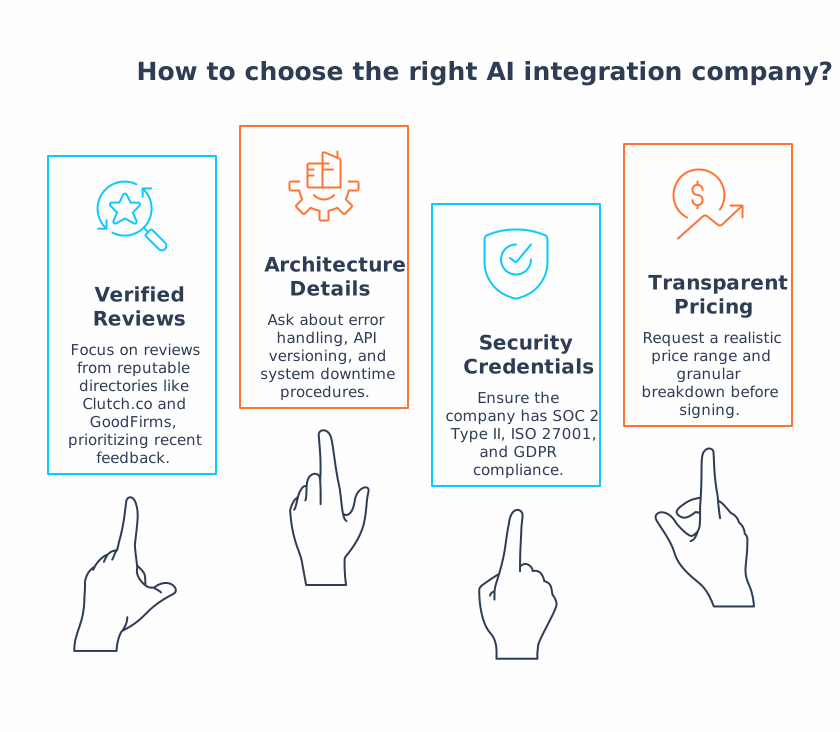
How Do You Choose the Right AI Integration Company?
Start with verified reviews, not marketing pages
Fancy websites lie. Verified directories don't - or at least, they lie less. Clutch.co and GoodFirms both check business registration, legal history, and actual client feedback before listing a provider. Hunt for agencies carrying a minimum 4.8 out of 5.0 rating, and pay close attention to recency. A rave review from 2023 might as well be ancient history; teams change, methodologies evolve, and the technical landscape shifts beneath everyone's feet. Reviews from the last six months are the ones that matter.
Ask about architecture, not just features
Demos are easy. Any halfway competent agency will show you one. Harder - and far more revealing - is asking them to walk you through how they handle error states, API versioning conflicts, and what happens when a connected system goes down at two in the morning on a bank holiday weekend. These unglamorous details separate integrations that hold up under real-world pressure from brittle point-to-point connections that snap the moment something unexpected happens. Ask for architecture diagrams. Mention deprecated endpoints. Watch their reaction carefully.
Confirm security and compliance credentials
SOC 2 Type II. ISO 27001. A proper Data Processing Agreement aligned with GDPR. These aren't nice-to-haves - they're the absolute baseline. And the stakes just got higher: the EU AI Act becomes fully applicable on 2 August 2026. Any integration partner you hire this year should already be weaving compliance into the fabric of your implementation, not bolting it on as an afterthought.
Demand transparent pricing
When a provider dodges the pricing question - "we'd need to assess your requirements first" with no ballpark in sight - that's a warning sign. It often signals either limited experience with similar projects or a deliberate strategy to widen scope once you've signed. A credible AI integration company gives you a realistic range in the first proper conversation and a granular breakdown before any contract lands on your desk.
Reputable AI Integration Companies for European Businesses in 2026
Below you'll find a curated shortlist covering both full-service agencies and self-service platforms. Every entry carries verified client feedback or a demonstrable track record in the European market. No pay-to-play listings here.
Full-Service Integration Agencies
| Company | Location | Clutch Rating | Typical Budget | Best For |
|---|---|---|---|---|
| Flexi IT | Ukraine (serving UK & Europe) | 5.0 | €10,000 – €50,000 | Mid-market AI integration, workflow automation, web development |
| Softblues | London, UK | 5.0 (32 reviews) | From €10,000 | Full-stack JS, CRM integration, legacy system modernisation |
| ML6 | Netherlands, Belgium, Germany | - | Enterprise-level | Enterprise AI consulting, OpenAI services partner |
| Vention | London, UK | 4.9 (98 reviews) | €50,000 – €199,000 | Enterprise-grade engineering, large-scale AI projects |
| Notch | London, UK | 4.9 (19 reviews) | From €50,000 | Mission-critical ML/AI, complex integrations |
| Innowise | London + European offices | 4.9 (72 reviews) | €10,000 – €199,000 | Staff augmentation, rapid specialist sourcing |
Self-Service Integration Platforms
| Platform | Connectors | Starting Price | Best For |
|---|---|---|---|
| Make | 1,500+ | €9/month | Visual workflow building, GDPR-friendly, European-founded |
| Zapier | 7,000+ | ~€19/month | Broadest app library, simple trigger-action automations |
| n8n | 400+ | Free (self-hosted) / ~€20/month (cloud) | Engineering-led teams, data residency control, open-source |
| Workato | 1,000+ | ~€50,000/year | Enterprise iPaaS, regulated industries, advanced governance |
Platform-Based vs Agency-Based Integration: Which Is Right for You?
Most businesses don't face an either/or choice here. It comes down to how messy the problem is.
Choose a platform (Make, Zapier, n8n) when:
- You're connecting two or three well-known apps (e.g., HubSpot → Slack → Google Sheets).
- Your workflows follow standard trigger-action patterns.
- You have someone on the team comfortable with no-code tools.
- Speed matters more than customisation - you can be live in hours.
Choose an agency (Flexi IT, Softblues, ML6, etc.) when:
- You need to connect legacy systems with modern cloud apps.
- Data transformation, custom AI models, or complex business logic is involved.
- Compliance requirements demand audit trails and formal governance.
- You don't have in-house technical staff to build and maintain integrations.
Here's what we see regularly at Flexi IT: a client starts with Make or Zapier, stitches together a few quick wins, and everything hums along nicely - until they need to pull data from an ancient on-premise ERP or bolt on a custom classification model. That's when they ring us. Perfectly logical approach, frankly. Why pay agency rates for something a €9/month tool does brilliantly on its own?
Fast Fact: SMB adoption of AI automation nearly doubled between 2024 and 2026, jumping from 22% to 38%, according to recent market data. The AI automation market itself is growing at 23.4% CAGR and is projected to reach roughly €18 billion this year.
What Will It Cost - and How Long Will It Take?
Costs by project type
- Simple workflow automation (2–5 apps, standard connectors): €5,000 – €15,000 with an agency, or €9–50/month with a platform.
- Mid-complexity integration (custom APIs, data transformation, 5–15 systems): €15,000 – €75,000.
- Enterprise-grade orchestration (legacy systems, regulatory compliance, AI model deployment): €75,000 – €150,000+.
Want a real-world anchor point? A 2026 study surveying 47 Dutch companies pegged the average AI project budget at €127,000. That number skews heavily towards larger, more ambitious implementations, though. If you're a European SME tackling your first integration project, expect to land somewhere between €10,000 and €50,000 - and be suspicious of anyone who quotes dramatically less without explaining exactly how.
Timelines
- Platform-based automations: Hours to days.
- Standard agency projects: 3–12 weeks from kickoff to go-live.
- Complex enterprise integrations: 3–6 months, including testing and phased rollout.
What about ROI?
Good news first. Close to 60% of business process automation initiatives report a positive return within 12 months. An IBM study published late last year found that two-thirds of EMEA enterprises are registering meaningful productivity gains from AI, while separate Adecco research put the average daily time saving at roughly 1 hour per worker. Those figures add up fast across a team of fifty.
Fast Fact: European manufacturers using AI-powered workflow automation are reporting savings of €300,000+ annually across processes like order creation, invoice processing, and customer support handling.
Now the sobering bit. Only about 5% of enterprises manage substantial AI ROI once they try to scale company-wide. What separates that 5% from everybody else? Three things, consistently: they started with a tightly scoped problem rather than a vague ambition, they picked an integration partner with genuine domain expertise, and they resisted the very human temptation to automate absolutely everything in one go.
Red Flags When Evaluating an AI Integration Company
- "It depends on complexity" with no further detail - this usually means they haven't done enough comparable projects to estimate accurately.
- No recent references available - if they can't connect you with a happy client from the past six months, ask yourself why.
- "We work with any tech stack" - mature providers know their limits and will tell you upfront when something falls outside their expertise.
- Heavy upfront customisation - good agencies configure standard tools first and only build custom when genuinely necessary. Over-engineering creates maintenance debt.
- No mention of monitoring or governance - an integration without alerting and audit trails is a ticking time bomb, especially with the EU AI Act coming into full force this August.
Key Terms
| Term | Definition |
|---|---|
| API (Application Programming Interface) | A set of rules that allows different software applications to communicate with each other. |
| iPaaS (Integration Platform as a Service) | A cloud-based platform for building and deploying integrations between applications (e.g., Workato, Make). |
| Workflow Automation | Using software to execute business processes automatically based on predefined rules or AI-driven decisions. |
| Agentic AI | AI systems capable of setting goals, planning multi-step tasks, and executing them with minimal human oversight. |
| DPA (Data Processing Agreement) | A legally binding document outlining how a vendor handles your data, required under GDPR. |
Summary for the Time-Pressed
- An AI integration company connects your existing software and deploys AI-powered automations - think of it as digital plumbing with a brain.
- For simple automations, platforms like Make (from €9/month) or Zapier (~€19/month) get you live in hours.
- For complex, multi-system projects, agencies such as Flexi IT, Softblues, or ML6 deliver within 3–12 weeks, typically for €10,000–€75,000.
- European SME AI adoption nearly doubled since 2024, and the EU AI Act becomes fully applicable in August 2026 - compliance matters now.
- Nearly 60% of automation projects see positive ROI within 12 months, but proper scoping is non-negotiable.
- Verify providers through Clutch or GoodFirms. Demand recent references, transparent pricing, and a proper DPA.
Ready to Connect Your Systems?
Trying to figure out which AI integration company actually fits? We're happy to talk - no slide decks, no hard sell. Flexi IT helps European businesses plug their software stacks together, strip out repetitive manual work, and put AI to use where it genuinely earns its keep. Get in touch, and we'll tell you honestly what's worth automating - and, just as importantly, what isn't.


