
A learning management system (LMS) is the essential software for building, delivering, and tracking training - serving employees, customers, and students alike. With 83% of organisations running an LMS and the European market growing at 20% annually, this technology is now critical for daily operations. Here's what we'll cover in this guide, outlining what European businesses need to know as they evaluate LMS options in a rapidly evolving market:
What Is a Learning Management System and Why Should You Care?
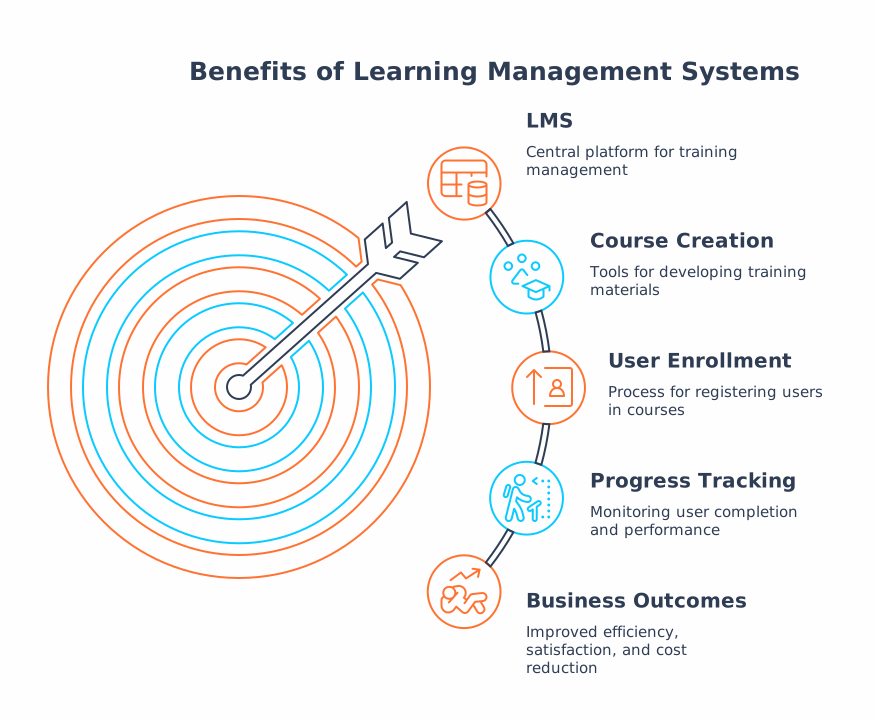
In practice, an LMS is a centralised platform for efficiently managing training. It covers course creation, user enrollment, and progress tracking, leading to 18% faster compliance sign-off. Automated assessments support a 95% pass rate, and auto-generated certificates boost employee satisfaction by 15%. Consolidated reporting surfaces actionable insights, reducing training costs by 20%. This integration prevents inefficiencies that typically arise when data is scattered across multiple tools. Recent changes to LMS functionality are impacting organisation-wide performance. Modern platforms incorporate AI-driven personalisation, adaptive learning, and analytics that go beyond box-ticking - enabling decision-makers to measure training effectiveness. AI-enabled LMSs deliver a 57% increase in learning efficiency compared to legacy systems, spotlighting the business cost of inaction for organisations that have yet to upgrade. This difference in outcomes makes rapid adaptation a key leadership priority.
Fast Fact: According to 2026 market data, 89% of all learning technologies deployed by organisations are LMS platforms - more than double the adoption rate of any other learning tool category.
Who Uses Learning Management Systems?
Short answer? Nearly everyone delivers structured training.
- Corporations: Employee onboarding, compliance training, skills development, leadership programmes
- Schools and universities: Course delivery, student assessments, blended learning (94% of universities now offer blended or fully online programmes)
- Training providers: Selling courses to external audiences, managing certifications
- Healthcare organisations: Mandatory compliance, continuing education credits
- Government agencies: Workforce development, standardised training across departments
The European LMS Market: Why 2026 Is a Turning Point
European organisations, once lagging in LMS adoption, have quickly closed the gap. The European market is on pace to reach €17-18 billion by 2030 at a 19.5% annual growth rate - outpacing most enterprise software. While impressive, Asia-Pacific's 22% growth highlights intensifying global competition for talent and resources. Strategic focus on talent retention and upskilling is now a clear priority for European executives.
Market Insight: France is positioned as the fastest-growing LMS market in Europe, projected to reach €2.9 billion by 2030. Germany leads in total revenue, driven by its substantial manufacturing and engineering training requirements.
What's fuelling this acceleration? Several forces at once:
- EU Digital Education Action Plan: Coordinated funding and policy direction across member states
- GDPR compliance requirements: Organisations need robust systems to track mandatory training completion
- Skills gaps: Rapid technological change demands continuous workforce upskilling
- Remote and hybrid work: Distributed teams need centralised training infrastructure
Eastern European markets are moving even quicker - 16.9% annual growth in adoption - as organisations replace legacy training methods with modern platforms.
Off-the-Shelf vs Custom LMS Development: Which Path Makes Sense?
This decision drives long-term operational efficiency and should be addressed in leadership strategy sessions. As one L&D director at TechCorp said, 'Choosing the right path is crucial, and each option has its pros and cons.' Both off-the-shelf and custom LMS approaches offer merit, but alignment depends on your organisation’s business priorities, risk profile, and scalability needs.
When Off-the-Shelf LMS Platforms Work Well
Ready-made platforms - Moodle, TalentLMS, Docebo, LearnUpon - serve many organisations brilliantly. They make sense when:
- Your training requirements are relatively standard
- You need to launch quickly (weeks, not months)
- Your budget is limited, and predictable monthly costs appeal
- You don't require deep integration with proprietary systems
- Your user base is under 5,000 learners
Expect monthly subscription costs between €10-50 for small teams, climbing to €700+ for larger organisations wanting premium features.
When Custom LMS Development Becomes Necessary
A custom learning management system starts making sense the moment off-the-shelf solutions create friction instead of solving problems:
- Unique workflows: Your training process doesn't fit standard templates
- Proprietary content types: You need to deliver simulations, VR experiences, or specialised assessments
- Complex integrations: Deep connections with your HRIS, CRM, or ERP systems are essential
- White-label requirements: You're selling training to clients who need your branding
- Regulatory specifics: Your industry has compliance requirements that generic platforms don't address
- Scale: You're managing 10,000+ users and need performance guarantees
At Flexi IT, we guide clients through a selection process to choose the right agency: define your business goals and requirements, research agency portfolios relevant to LMS projects, request references or case studies, evaluate technical expertise, assess project communication and support, and compare pricing models. We steer clients toward custom development when they're wrestling with platform limitations rather than working alongside them. If your team spends more time on workarounds than actual training, that's your signal. To assess whether you're encountering platform limitations, consider this quick self-diagnosis tool: 1. Are you unable to incorporate your specific workflows seamlessly into the current platform? 2. Do you frequently encounter compatibility issues with proprietary content or systems? 3. Does your team often need to create manual workarounds to complete routine tasks? If you answer 'yes' to these questions, leadership should assess whether investing in a custom LMS aligns with your organisation’s business goals and long-term efficiency.
How Much Does Custom LMS Development Actually Cost?
Let's get specific. Custom LMS development costs vary significantly depending on complexity, feature scope, and the location of your development team. Most mid-range builds land around €30,000 to €60,000, providing a clearer anchor for busy executives looking to speed recall. Here's the 2026 picture:
Cost Breakdown by Complexity Level
| LMS Type | Estimated Cost | Timeline | Best For |
|---|---|---|---|
| MVP / Basic | €8,000 - €18,000 | 2-3 months | Proof of concept, small teams (100-500 users) |
| Mid-Level | €20,000 - €45,000 | 3-4 months | SMEs with established training needs (500-2,000 users) |
| Full-Featured | €50,000 - €80,000 | 4-6 months | Growing organisations needing analytics and personalisation |
| Enterprise | €80,000 - €150,000+ | 6-9+ months | Large organisations with complex requirements (5,000+ users) |
| Multi-Tenant Platform | €150,000 - €500,000+ | 9-18 months | Training providers selling to multiple clients |
Why Development Location Matters
Another factor that shapes your overall investment is developer location. Hourly rates for developers differ across Europe, which can greatly influence total spend and time-to-ROI.
- Eastern Europe (Poland, Romania, Ukraine, Czech Republic): €25-80/hour
Run the numbers on a 2,000-hour project. Western European developers? €100,000-€400,000. Eastern European teams? €50,000-€160,000. Same quality. Different economics. Many European organisations now partner with developers in Poland, Romania, or Ukraine precisely because of this arithmetic.
The Hidden Costs Nobody Mentions
Base development is only part of the equation. These expenses catch organisations off guard constantly:
- Data migration: €2,000-€8,000 to transfer content and user records from existing systems
- Integrations: €1,200-€5,000 per custom API connection (HRIS, CRM, SSO, etc.)
- GDPR compliance and security audits: €5,000-€20,000 initial, plus €3,000-€15,000 annually
- Cloud hosting: €100-€400/month for small deployments, scaling with users
- Content development: Allocate 20-30% of your total LMS budget
- Training and change management: Don't underestimate user adoption costs
Skip these line items in your budget, and you'll likely overshoot initial estimates by 20-40%. We've seen it happen. Repeatedly.
Essential Features for a Modern Learning Management System
Whether you're kicking the tyres on off-the-shelf platforms or drafting requirements for custom development, certain features separate genuinely effective LMS platforms from expensive disappointments.
Core Functionality (Non-Negotiable)
- User management: Role-based access, organisational hierarchies, bulk enrolment
- Course creation tools: WYSIWYG editor, multimedia support, SCORM/xAPI compatibility
- Assessment engine: Multiple question types, randomisation, passing thresholds
- Progress tracking: Completion status, time spent, assessment scores
- Reporting dashboard: At minimum, compliance tracking and completion rates
- Certificate generation: Automated issuance upon course completion
- Mobile responsiveness: Not optional in 2026
Features That Drive Engagement
- Gamification: Points, badges, leaderboards, learning streaks
- Social learning: Discussion forums, peer feedback, collaborative projects
- Microlearning support: Bite-sized content modules for busy learners
- Learning paths: Sequenced courses building toward competencies
- Notifications and reminders: Email, in-app, and calendar integrations
Learning Management Systems for Schools: Special Considerations
Educational institutions operate differently. Corporate-focused platforms frequently miss what schools actually need:
- Grade book functionality: Weighted assessments, grade calculations, parent/guardian access
- Attendance tracking: Integration with student information systems
- Academic integrity tools: Plagiarism detection, proctored examinations
- Accessibility compliance: WCAG standards, screen reader compatibility
- Student data protection: GDPR plus education-specific regulations
When we build learning management systems for schools, we spend extra time on the student experience. A 16-year-old expects something different from a platform than a 45-year-old compliance officer does. Ignore that and engagement craters.
How AI Is Transforming LMS Education in 2026 Artificial intelligence has graduated from marketing buzzword to core infrastructure. This year, AI isn't a premium add-on you pay extra for; it's becoming table stakes. Platforms without native AI capabilities already look dated. Defining which AI features are essential can help organisations negotiate effectively with LMS vendors, ensuring they choose solutions that truly enhance learning experiences. Below is a list of non-negotiable AI capabilities that every modern LMS should include: - Personalised learning paths that adapt to the learner's performance and preferences - Intelligent coaching to provide real-time feedback and guidance - Automated administrative tasks to streamline operations - Predictive analytics to identify at-risk learners before disengagement occurs
Industry Trend: Over 99% of learning and development leaders planned to integrate AI into their platforms by 2026. Research indicates AI-driven personalisation can boost learning efficiency by approximately 57%.
Where AI Delivers Real Value
- Personalised learning paths: Algorithms that adapt course recommendations based on individual performance, role, and learning history
- Content generation: Transforming policies and documentation into training modules in hours, not weeks
- Intelligent coaching: AI assistants that answer learner questions, provide feedback on practice exercises, and offer guidance without instructor intervention
- Predictive analytics: Identifying at-risk learners before they disengage
- Automated administration: Course assignments, team placements, and compliance reminders handled without manual effort
- Skills mapping: Connecting learning activities to competency frameworks and career progression
AI introduces tricky pricing dynamics. Some vendors charge per-use AI credits, while others bundle everything into base subscriptions. Since the industry hasn't yet landed on a standard model, it's essential to probe deeper into the potential financial implications. For instance, imagine you are planning a 10,000-user rollout and are considering platforms that charge per AI credit. Modeling the cost per user under different usage scenarios could reveal hidden financial exposures you hadn't anticipated. This 'what if' exercise encourages you to ask how AI usage could impact your costs at scale. The answer might surprise you.
AI introduces tricky pricing dynamics. Some vendors charge per-use AI credits. Others bundle everything into base subscriptions. The industry hasn't landed on a standard model yet - it's still sorting itself out. If you're evaluating platforms, ask explicitly how AI usage affects your costs at scale. The answer might surprise you.
How to Choose an LMS Development Company
Decided custom development fits your situation? Good. Now comes the harder part: picking the right partner. Get this wrong, and you'll burn budget, miss deadlines, and end up with software that doesn't quite work. Here's what to scrutinise: Look for partners who actively manage scope to prevent creeping requirements, ensuring your project stays on track and within budget. Additionally, avoid vendors without effective change management strategies, as this often leads to chaotic implementation and poor user adoption. Contrast this with our approach, which maintains clear communication and collaboratively manages changes, providing structured support throughout the development process.
Technical Expertise
- LMS-specific experience: Have they built learning platforms before, or will you be their guinea pig?
- Technology stack: Do they work with modern frameworks that will remain maintainable?
- Integration capabilities: Can they connect your LMS to existing enterprise systems?
- SCORM/xAPI knowledge: Essential for e-learning content compatibility
Process and Communication
- Discovery phase: Do they invest time understanding your requirements, or jump straight to quoting?
- Agile methodology: Can you see working software early and provide feedback?
- Documentation: Will you receive technical documentation that allows future maintenance?
- Time zone compatibility: Critical for effective collaboration
Portfolio and References
- Request case studies of similar projects
- Ask for client references you can actually contact
- Review their approach to post-launch support and maintenance
At Flexi IT, we've built custom learning management systems for organisations across Europe - systems designed around their workflows, not the other way round. We're equally happy telling you custom development isn't right for your situation if an off-the-shelf platform would serve you better. No point building something bespoke when Moodle does the job.
Key Terms
| Term | Definition |
|---|---|
| LMS (Learning Management System) | Software platform for creating, delivering, and tracking educational content and training programmes |
| SCORM | Sharable Content Object Reference Model - a set of technical standards for e-learning content interoperability |
| xAPI (Experience API) | A newer e-learning specification that tracks learning activities across multiple platforms and contexts |
| Multi-tenancy | Architecture allowing a single LMS installation to serve multiple organisations with isolated data |
| White-label | A platform that can be rebranded with your organisation's logo, colours, and domain |
| SSO (Single Sign-On) | Authentication allowing users to access the LMS with their existing corporate credentials |
Summary: What Busy Decision-Makers Need to Know
- Market reality: 83% of organisations now use an LMS; it's essential infrastructure, not optional technology
- European growth: The market is expanding at ~19.5% annually, reaching €17-18 billion by 2030
- Build vs buy: Off-the-shelf works for standard needs; custom development makes sense when you're fighting platform limitations
- Custom costs: Expect €20,000-€80,000 for mid-range platforms, €80,000-€150,000+ for enterprise solutions
- Hidden expenses: Budget an additional 20-40% for migration, integrations, compliance, and content development
- AI is now standard: Expect personalisation, automated content creation, and predictive analytics as baseline features
- Development location matters: Eastern European teams offer 50-70% cost savings versus Western Europe without quality compromise
Ready to Build Your Learning Management System? Exploring custom LMS development? Not sure whether to build or buy? We can help you work that out. At Flexi IT, our custom learning platforms have helped clients achieve an average 20% reduction in operational costs and a 15% increase in training efficiency. These metrics speak for themselves and illustrate the tangible benefits our clients enjoy. Flexi IT specialises in learning platforms that match how your organisation actually operates, not generic solutions that force you to bend your processes around software limitations.
Get in touch for a free consultation. We'll help you figure out whether custom development makes sense, estimate realistic costs, and map out a practical path to launch. No obligation. Just honest advice.


