
Need a custom LMS? Imagine a platform built exactly for your needs, boosting revenue by 30% by removing every learning barrier. To get there: search Clutch or GoodFirms for proven LMS agencies, confirm real platform experience, check their security chops, and budget €25,000–€150,000 based on your requirements. Most projects require 4–9 months. European firms - especially in Poland, Romania, or the Baltics - offer top quality at €45–€100 an hour, often at half the cost of London or Berlin. Read on to see how these steps fit into the process, and what to watch out for along the way.
This guide covers:
- Beat off-the-shelf limits with a custom LMS for your education business
- Discover reputable web development agencies with LMS expertise
- Evaluate agencies using essential criteria and spot red flags
- Understand realistic cost breakdowns and timeline expectations for 2026
- Choose contract models that protect your investment
- Structure a discovery phase effectively before committing
Why Build a Custom Learning Management System Instead of Buying One?
Moodle works. Canvas works. Blackboard has its fans. These platforms handle standard teaching scenarios perfectly well, and for plenty of schools, they're the right choice. But here's the thing: if your education business has specific workflows, unusual branding needs, or must plug into systems the off-the-shelf options don't support, you'll spend more time fighting the software than using it. In fact, an education company could waste up to 20% of its operational hours adapting to inadequate platforms, leading to significant revenue losses annually.
Subscriptions pile up. Customisation hits a wall. And your product roadmap? Someone else controls it entirely.
Building custom changes that dynamically change completely. You pick the features. The code belongs to you. Integration with your student information system, payment gateway, or video conferencing tool happens directly - no clunky middleware, no plugin headaches, no waiting for a vendor to maybe add support in next year's release.
Market Insight: The European LMS market reached €9.4 billion in 2025 and is projected to grow at 19.4% annually through 2033. With 80% of learning professionals now prioritising AI-powered analytics, custom builds increasingly outpace generic platforms in meeting evolving expectations.
Custom development particularly makes sense when you're dealing with:
- Unique assessment types - specialised testing formats for vocational training or certification programmes
- Complex user hierarchies - multi-tenant systems serving schools, districts, or franchise networks
- Deep integrations - seamless connections with HRIS, CRM, or proprietary data systems
- White-label capabilities - fully branded experiences for B2B education providers
- Compliance requirements - GDPR, accessibility standards, or sector-specific regulations
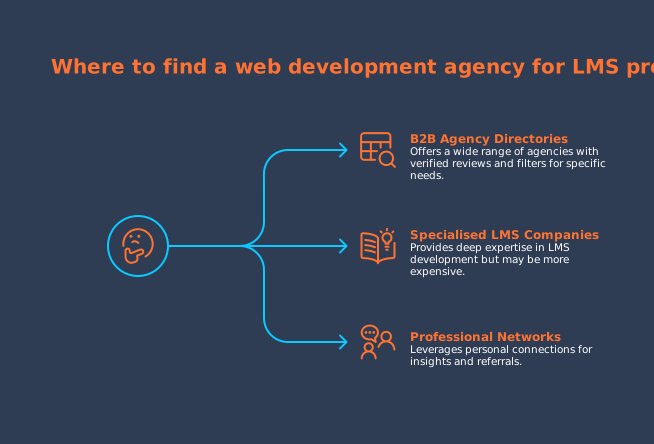
Where Can You Find a Web Development Agency for LMS Projects?
Most web development agencies haven't touched an LMS. They build marketing sites, maybe an e-commerce platform or two. Learning systems are entirely different animals - course content management, progress tracking, SCORM compliance, assessment engines. These require specific know-how. So, where do you actually find specialists?
B2B Agency Directories
Clutch.co is where serious buyers start. Filter by "LMS development," pick your region, set hourly rate boundaries, and specify minimum project size. Agencies scoring 4.7 stars or higher with documented education technology case studies deserve your attention. Clutch verifies reviews through actual client interviews - that accountability matters more than you'd think.
Visit GoodFirms and DesignRush to find additional agencies, each platform offering different rosters. Review and compare candidates from each source. Prioritise those who appear consistently and provide strong feedback, as this signals reliability on your shortlist.
The Digital Agency Network (DAN) specialises in European agencies specifically. Useful if timezone alignment and GDPR familiarity rank high on your priorities.
Specialised LMS Development Companies
Some firms do nothing but build learning platforms. They understand xAPI tracking, competency frameworks, certificate automation - all the domain-specific stuff that general web shops need weeks of briefing to grasp. Yes, specialists charge more per hour. They also finish faster because they've solved your problems before on someone else's dime.
Professional Networks and Referrals Talk to people. Seriously. Which other education businesses have these agencies used? Use direct, impactful questions like, "What almost derailed the project?" or "What would you do differently if you were to start over?" These conversations can unearth insights that no case study will ever mention. Would they hire the same team again? The agency that looks brilliant on paper might be a nightmare to work with. You won't know until someone who's been through it tells you.
At Flexi IT, we've delivered custom web applications for education providers across Europe. We're happy to chat about whether a bespoke LMS fits your situation - even if we're ultimately not the right partner for your particular project.
What Should You Look for When Evaluating Agencies?
Finding agencies is the easy part. Telling the excellent from the adequate? That takes work.
Demonstrated LMS Experience
Web development skills don't automatically mean LMS competence. Different discipline. Ask specifically about:
- Previous learning platform projects (request live URLs you can test)
- Experience with SCORM, xAPI, or LTI integrations
- Understanding of learner progress tracking and reporting
- Familiarity with accessibility standards (WCAG 2.1)
Get references from the education sector clients. Then actually phone them. Ask what went wrong - not just the highlight reel.
Security Certifications
Student data isn't something you gamble with. Look for:
- SOC2 Type II - validates security controls for service organisations
- ISO 27001 - information security management certification
- GDPR compliance documentation - essential for European operations
Any decent agency will explain its encryption approach, authentication setup, backup protocols, and audit logging without breaking a sweat. Hesitation here? Walk away.
Team Composition and Stability
Sobering Statistic: Approximately 70% of digital transformation projects fail, with inadequate team expertise and poor vendor selection among the primary causes. However, there is a proven safeguard: start your project with a comprehensive discovery phase. This allows a thorough analysis and understanding of your specific requirements, significantly reducing risks and increasing the chance of success for your LMS development project.
Who actually touches your project matters enormously. Ask for names. Check experience levels. Find out if these specific developers have shipped LMS platforms before. What's the agency's average employee tenure? Revolving-door shops leak institutional knowledge and deliver inconsistent quality.
Dedicated team arrangements - where developers focus solely on your project for its duration - tend to outperform setups where your work competes with three other clients for attention.
Communication Style
Evaluate agency engagement: do they ask targeted questions about your business goals and constraints, or do they propose solutions prematurely? Select partners who demonstrate a deep understanding of your business and challenge assumptions constructively.
How Much Does Custom LMS Development Cost in 2026?
Nobody loves talking money. Let's do it anyway. Transparency beats surprises.
Project Cost Ranges
| LMS Complexity | Typical Cost Range | Timeline |
|---|---|---|
| MVP / Basic LMS | €25,000 – €45,000 | 2-4 months |
| Mid-complexity LMS | €60,000 – €120,000 | 4-6 months |
| Enterprise / Full-scale LMS | €120,000 – €150,000+ | 6-9 months |
For instance, an MVP typically costs between €25,000 – €45,000, and aligns with the business milestone of validating your concept in 2-4 months. A mid-complexity LMS, which can cost €60,000 – €120,000, supports scaling operations and optimising workflows within a 4-6 month timeline. For enterprises aiming for comprehensive digital transformation, the investment might range from €120,000 – €150,000+, with major enhancements ready in 6-9 months. These numbers assume European teams. North American agencies? Add 40-60% to those figures for equivalent work.
| Region | Contractor Hourly Rate |
|---|---|
| Western Europe (UK, Germany, Netherlands) | €60 – €100 |
| Central/Eastern Europe (Poland, Romania, Ukraine) | €40 – €70 |
| North America | €95 – €190 |
Central and Eastern European agencies punch well above their weight. Polish developers consistently rank among the world's best in competitive coding assessments - yet charge 35-40% less than their Western European counterparts. Quality gap? Minimal for the vast majority of projects.
What Drives Costs Up?
- AI-powered features - adaptive learning paths, intelligent recommendations, automated content generation
- Complex integrations - connecting with legacy systems, payment processors, or video platforms
- Multi-tenant architecture - supporting multiple organisations from a single codebase
- Compliance requirements - HIPAA, FERPA, or sector-specific regulations
- Mobile applications - native iOS/Android apps alongside the web platform
Should You Run a Discovery Phase First? Yes. Full stop. No exceptions. Discovery is a focused engagement - typically 2-6 weeks, costing €2,000-€4,000 - where the agency properly analyses your requirements before anyone commits to full development. It's the single most effective way to kill project risk before it kills your budget. A successful discovery phase can significantly cut change orders by approximately 25%, making the €3,000 spend feel more like insurance rather than an overhead.
What Discovery Delivers
- Detailed requirements documentation based on stakeholder interviews
- Technical architecture recommendations
- Wireframes or clickable prototypes showing proposed interfaces
- Refined cost and timeline estimates based on actual complexity
- Risk assessment highlighting potential challenges
Good discovery regularly proves initial assumptions wrong. Features you assumed were critical turn out to be nice-to-haves. Requirements that sounded simple hide nasty complexity underneath. Far better to learn this during a €3,000 engagement than midway through a €100,000 build.
We at Flexi IT push for discovery even when clients want to skip straight to building. The upfront cost pays for itself several times over in avoided rework and sharper expectations on both sides.
What Red Flags Should You Watch For?
Some signals scream "run away." Learn to spot them early.
Immediate Disqualifiers
- Vague answers to specific questions - if they can't explain their LMS development process clearly, they probably don't have one
- "We do everything" positioning - agencies claiming expertise across all technologies rarely have depth in any
- Unrealistic timelines - a functional custom LMS in 3 weeks? That's not confidence, it's delusion
- Full payment upfront - legitimate agencies work with milestone-based payment schedules
- Defensiveness when challenged - good partners welcome hard questions
Portfolio Verification
Actually, check that showcased projects exist. Visit the URLs. Click around. Test things. Phone the client organisations if you can. Fabricated portfolios happen more often than the industry likes to admit.
Communication Gaps
Slow responses during sales? Red flag. They're trying to win your business right now - this is them at their most attentive. Imagine how responsive they'll be six months into development when you're already locked in.
Which Contract Model Works Best for LMS Development?
Two models dominate. Each has trade-offs.
Fixed-Price Contracts
Pros: Budget certainty. You know the final number before signing.
Cons: Requires rock-solid requirements upfront. Changes cost extra - sometimes a lot extra. Agencies inflate estimates to cover unknowns, so you often end up overpaying.
Best for: Smaller projects where requirements are genuinely stable and well-understood.
Time-and-Materials (T&M) Contracts
Pros: Flexibility. Scope adjusts as understanding deepens. You pay for actual work, nothing more.
Cons: Demands active oversight. Without proper management, costs spiral.
Best for: Complex builds where requirements will shift, which describes most custom LMS projects honestly.
Hybrid Approaches
Plenty of successful projects blend both. Fixed price for discovery and design, with a definable scope. T&M for development where requirements inevitably evolve. You get budget predictability where it's achievable and flexibility where it's necessary.
Non-Negotiable Contract Terms
Whatever pricing model you choose, these terms aren't optional:
- Intellectual property transfer - you own all custom code and designs
- Milestone-based payments - tied to deliverable acceptance, not calendar dates
- Clear acceptance criteria - how you'll determine if work meets specifications
- Termination provisions - reasonable exit conditions for both parties
- Source code access - full repository access throughout the project
What Features Should Your Custom LMS Include?
Every education business differs. That said, certain functionality appears in nearly every custom learning management system worth building:
Essential Features
- Course creation and management - structured content organisation with multimedia support
- User management - roles, permissions, and enrolment workflows
- Progress tracking - completion status, time spent, and assessment scores
- Assessment tools - quizzes, assignments, and grading capabilities
- Reporting dashboards - analytics for administrators and instructors
- Communication tools - announcements, messaging, and discussion forums
- Mobile responsiveness - functional experience across devices
Advanced Features Worth Considering
- AI-powered personalisation - adaptive learning paths based on performance
- Gamification elements - badges, leaderboards, and achievement systems
- Certificate generation - automated credential issuance
- E-commerce integration - course sales and subscription management
- Video conferencing - live session capabilities or integrations
- SCORM/xAPI compliance - interoperability with third-party content
Key Terms Glossary
| Term | Definition |
|---|---|
| LMS (Learning Management System) | Software platform for creating, delivering, and tracking educational content and learner progress. |
| SCORM | Shareable Content Object Reference Model - a technical standard enabling content interoperability between different LMS platforms. |
| xAPI (Experience API) | Modern standard for tracking learning experiences across multiple platforms and contexts, more flexible than SCORM. |
| LTI (Learning Tools Interoperability) | Standard allowing external tools and content to integrate seamlessly with an LMS. |
| Multi-tenant Architecture | System design allowing multiple organisations to use the same platform instance while keeping their data separate. |
| Discovery Phase | Initial project stage focused on requirements gathering, analysis, and planning before full development begins. |
| MVP (Minimum Viable Product) | Version of a product with just enough features to be usable, allowing for iterative improvement based on feedback. |
Summary: Your LMS Development Checklist
- Budget realistically: Expect €25,000-€150,000 for custom LMS development, with 4-9 month timelines depending on complexity.
- Source agencies carefully: Use verified directories (Clutch, GoodFirms) and filter for education sector experience and 4.7+ ratings.
- Prioritise LMS expertise: General web development skills don't guarantee understanding of learning platform requirements - look for specific SCORM, xAPI, and assessment experience.
- Verify everything: Check portfolios, call references, and confirm security certifications before signing contracts.
- Start with discovery: A €2,000-€4,000 discovery phase dramatically reduces project risk and improves cost estimates.
- Consider European agencies: Central and Eastern European developers offer 35-40% cost savings versus Western Europe or North America without sacrificing quality.
- Protect your investment: Ensure contracts include IP ownership, milestone payments, and clear acceptance criteria.
Ready to Explore Custom LMS Development?
A custom learning management system isn't a small commitment. It's real money and real time. But for education businesses whose needs don't neatly fit what Moodle or Canvas offers, building bespoke solutions often proves the smarter long-term play. The trick lies in finding a web development agency that genuinely grasps both the technical challenges and the educational reality you're operating in.
Thinking about a custom LMS? Let's talk. At Flexi IT, we build custom web applications for European clients - and we've got particular experience with platforms handling complex user workflows and tricky data requirements. Whether you're building from scratch or extending an existing project, our team can help you think through your options and map out a sensible path forward.
Get in touch for a straightforward conversation about your LMS project. No pressure, no obligation.


