
WordPress remains a solid investment for a straightforward reason: it gives you something website builders can't. Real ownership. Unlimited room to grow. And up to 44% lower costs when you tally everything up over time. Wix, Squarespace, Shopify - they all have their uses, but they're built for simplicity, not serious growth. WordPress website development hands businesses complete control over their digital property, opens doors to 65,000+ plugins, and lets you scale from a modest blog to enterprise-grade infrastructure without ripping everything out and starting over.
In this guide, we'll cover:
- The complex numbers behind WordPress's continued market dominance in 2026
- Why total cost of ownership favours WordPress over website builders
- The vendor lock-in trap that catches many businesses off guard
- How WordPress scales from startup to enterprise (with real examples)
- 2026 trends: AI integration, headless architecture, and WordPress 7.0
- When a website builder actually makes sense
What Do the Numbers Say About WordPress in 2026?
Data first. Opinions are cheap - numbers tell you what's actually happening.
2026 Market Reality: WordPress powers 43.4% of all websites globally - that's over 810 million sites. When you look only at websites using a known CMS, WordPress commands 62% of the market.
Think about what that means. Right now, as you read this, roughly 409 million people are viewing over 20 billion WordPress pages somewhere on the internet. Daily, 70 million fresh posts go live on WordPress sites. That's not a platform limping along on past glory. That's infrastructure. That's the plumbing of the modern web.
Now look at the competition:
| Platform | Overall Market Share | CMS Market Share |
|---|---|---|
| WordPress | 43.4% | 62% |
| Shopify | 4.6% | 6.5% |
| Wix | 3.2% | 3.8% |
| Squarespace | 2.3% | 3.0% |
Wix loves trumpeting its 282 million registered users. Sounds impressive. But registered accounts and active websites are very different animals. Someone signs up, pokes around for an afternoon, abandons the project - that's still a "user" in their count. WordPress's share climbed from 21% in 2014 to over 43% this year. That's not legacy momentum carrying a dying platform forward. That's sustained, deliberate expansion over a full decade.
Why Is WordPress More Cost-Effective Than Website Builders?
Here's where it gets properly interesting - especially if you're the one signing cheques.
A 2025 study surveyed 1,700 digital decision-makers across the UK, US, and Australia. The finding? Organisations running WordPress see up to 44% lower total annual costs than those running proprietary platforms. For medium-to-large enterprises, average yearly CMS expenses land around €2.4 million once you stack up licensing, hosting, agency retainers, and security overhead.
WordPress cuts that figure down through several mechanisms:
- No licensing fees: The core software is free. Forever. No per-user charges, no traffic-based pricing tiers.
- Competitive hosting market: Hundreds of providers compete for your business, driving prices down. Basic managed WordPress hosting starts at around €25-50 per month.
- Lower development costs: WordPress developers are abundant, which keeps hourly rates competitive. The mature ecosystem means less custom work - there's usually a plugin for that.
- Staff can handle routine updates: Your marketing team can publish content without calling a developer for every change.
The Five-Year Cost Comparison
Let's map this out for a typical business website:
| Cost Category | Website Builder (5 Years) | WordPress (5 Years) |
|---|---|---|
| Platform/Hosting | €3,000 - €6,000 | €1,500 - €3,600 |
| Premium Features/Plugins | €1,200 - €2,400 | €500 - €1,500 |
| Design Customisation | Limited (included) | €500 - €2,000 (one-time) |
| E-commerce Transaction Fees | 1-2% on all sales | 0% (direct processor only) |
| Flexibility to Scale | Constrained | Unlimited |
E-commerce widens this gap considerably. Website builders skim transaction fees on top of what your payment processor already takes. WooCommerce doesn't touch your revenue. Run €100,000 through your shop annually, and that 1-2% difference puts €1,000-2,000 back in your account every single year. Compound that over five years. It adds up fast.
What's the Real Risk of Website Builder Lock-In?
This catches people out constantly. Website builders feel effortless at first. Drag, drop, done. Then you try to leave.
WordPress runs on open-source code. You own everything - your templates, your content, your database, the lot. Hosting provider gets greedy? Export the site, move to a competitor. Takes a weekend, maybe less. Entirely doable.
Website builders work differently. Very differently.
- Wix: Cannot export your design. Content export is limited. Switching means rebuilding from scratch.
- Squarespace: Basic content export available, but designs don't transfer. Your carefully crafted layouts stay behind.
- Shopify: Product data exports reasonably well, but your theme, apps, and customisations don't come with you.
This isn't accidental. It's the business model. Builder platforms profit by making departure painful. WordPress profits by being genuinely useful - so you stay because you want to, not because leaving would cost you three months of reconstruction.
The Ownership Question: With WordPress, you're building equity in a digital asset you control. With website builders, you're renting a shopfront that someone else owns.
For any business thinking past next quarter, this distinction carries real weight. We've guided clients at Flexi IT through migrations away from Squarespace and Wix after they outgrew those platforms. It's never a quick job. Starting on WordPress sidesteps that headache entirely.
Can WordPress Really Scale From Startup to Enterprise?
Short answer: absolutely. Longer answer: look at who's betting on it.
TechCrunch runs WordPress. So does Bloomberg. BBC America. The Walt Disney Company. Microsoft. The White House. These organisations don't tolerate flaky infrastructure. They picked WordPress because it handles scale without flinching.
The technical architecture backs this up:
- Small sites: Basic shared hosting at €20-50/month handles thousands of daily visitors without breaking a sweat.
- Growing businesses: Managed WordPress hosting (€30-150/month) adds caching, CDN integration, and automatic scaling.
- Enterprise operations: Platforms like WP Engine, Kinsta, or Pantheon provide containerised infrastructure, Redis caching, and geographic distribution for millions of daily visitors.
Here's the crucial bit: you never rebuild from scratch as you grow. Same WordPress codebase. Same themes. Same plugins. They work identically across every tier. Your investment in WordPress development services accumulates value over time instead of turning into technical debt you'll eventually need to write off.
Website builders hit walls. Wix and Squarespace handle modest traffic well, but performance starts to degrade once visitor numbers climb. Reach the point where you genuinely need robust infrastructure, and you're staring at a complete rebuild on an entirely different platform. Everything you built? Left behind.
How Is WordPress Evolving for 2026 and Beyond?
WordPress isn't coasting on market share. The platform is actively integrating technologies that will shape web development over the next decade.
AI Integration: Beyond Plugins
AI capabilities are shifting from bolt-on extras into core WordPress functionality. This year brings several notable developments:
- AI-powered personalisation: Sites that analyse visitor behaviour and serve customised content in real-time. Particularly powerful for WooCommerce stores where personalised recommendations directly impact conversion rates.
- Content creation assistance: AI tools that generate outlines, draft posts, and optimise meta descriptions - not replacing writers, but accelerating their output.
- Intelligent chatbots: AI assistants that handle roughly 80% of routine customer enquiries automatically, using your actual site content for accurate responses.
None of this is gimmickry. These are productivity multipliers - tools that let lean teams punch above their weight against much larger competitors.
Headless Architecture: The Best of Both Worlds
Headless WordPress decouples content management from presentation entirely. WordPress manages the backend - content, products, data - while a modern JavaScript framework like React, Vue, or Next.js handles what visitors actually see.
Industry Insight: A WP Engine study found that 92% of respondents agreed that headless CMS technologies make it easier to deliver consistent content experiences across multiple channels.
Why should you care? Two words: performance and flexibility. A headless configuration can push identical content to your website, your mobile app, digital signage in your lobby, and voice assistants - all from a single WordPress backend. For businesses building omnichannel experiences, this architecture isn't optional anymore. It's becoming a baseline expectation.
WordPress 7.0: What's Coming
WordPress 7.0, slated for later this year, zeroes in on collaboration:
- Notes: Asynchronous commenting directly on content blocks so that teams can collaborate without external tools.
- Block visibility controls: Hide unfinished sections from visitors while continuing to develop them.
- Native multilingual support: Coming in Phase 4 of Gutenberg, eliminating the need for third-party translation plugins.
The platform is also strengthening data portability - making it simpler to shift content between WordPress installations or export to other systems entirely. That's a deliberate strategic move. WordPress competes by being useful, not by trapping users behind artificial barriers.
When Does a Website Builder Actually Make Sense?
We'd be misleading you if we claimed WordPress suits every situation. It doesn't.
Website builders genuinely make sense when:
- You need a simple portfolio or brochure site with minimal ongoing changes
- You have zero budget for professional WordPress development services
- You're testing a business idea and need something live within hours, not days
- Long-term scalability genuinely isn't a concern
Squarespace, specifically, produces gorgeous designs with minimal fuss. For a freelance photographer or a neighbourhood café wanting basic online visibility, that might be precisely the right tool. No shame in it.
But if you're constructing something designed to expand - an e-commerce operation, a content-driven brand, a platform requiring integration with external systems - WordPress website development becomes the smarter strategic play. Initial investment runs slightly higher. Long-term returns run substantially higher still.
Key Terms
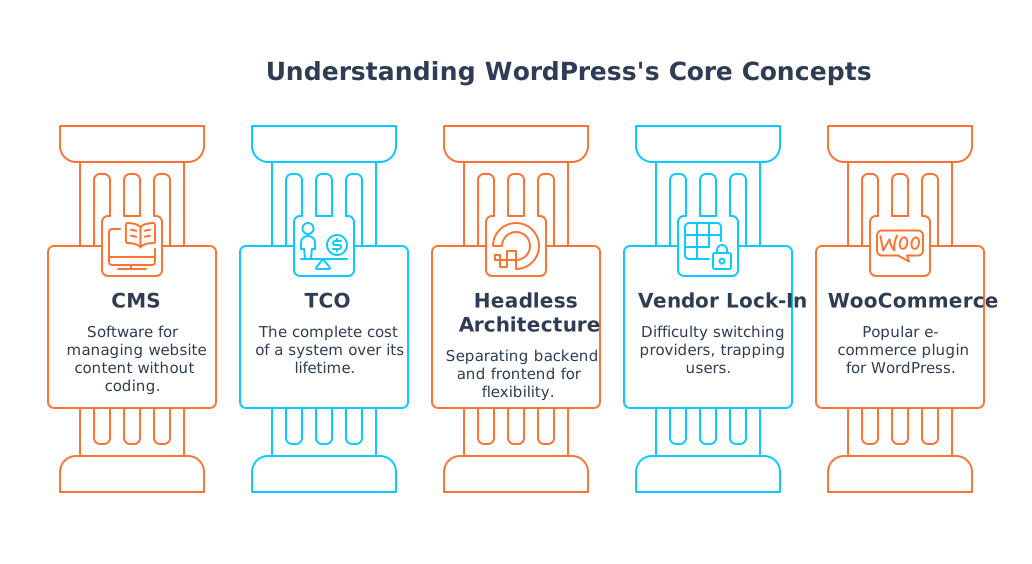
- CMS (Content Management System)
- Software that helps you create, manage, and modify website content without needing to write code directly. WordPress is the world's most popular CMS.
- Total Cost of Ownership (TCO)
- The complete cost of a system over its lifetime, including initial setup, ongoing maintenance, licensing, and eventual migration or replacement costs.
- Headless Architecture
- A setup where the content management backend (WordPress) is separated from the frontend presentation layer, connected only by APIs. Enables greater flexibility and performance.
- Vendor Lock-In
- A situation where switching to a different provider is prohibitively difficult or expensive, effectively trapping you with your current vendor.
- WooCommerce
- The most popular e-commerce plugin for WordPress, powering approximately 17% of all online stores globally.
Summary: Why WordPress Remains the Smart Investment
- Market dominance: WordPress powers 43.4% of all websites and 62% of the CMS market - and it's still growing.
- Cost efficiency: Up to 44% lower total costs compared to proprietary alternatives, with no licensing fees and competitive hosting options.
- True ownership: You control your code, content, and data. No vendor lock-in, no rebuilding if you need to move.
- Unlimited scalability: The same platform serves small blogs and enterprise sites like TechCrunch and the White House.
- Future-ready: AI integration, headless architecture, and WordPress 7.0 features keep the platform at the cutting edge.
- Ecosystem depth: 65,000+ plugins, 30,000+ themes, and 900+ companies contributing to core development.
- Website builders have their place:, but for businesses planning to grow, WordPress is the foundation that scales with you.
Ready to Invest in WordPress the Right Way?
At Flexi IT, we build WordPress websites meant to last. Whether you need fresh WordPress site design, custom WordPress themes development, or reliable WordPress website maintenance, our team creates solutions that expand alongside your business.
We've helped European companies escape limiting website builders, deploy headless architectures, and develop custom WordPress plugins that solve specific operational problems - weighing your options? Ready to break ground? Either way, we're happy to walk through what makes sense for your particular situation.
Get in touch with Flexi IT to discuss your WordPress project.


