
Yes, several web scraping services can legally pull product pricing data from your competitors' websites. The catch? They must only scrape publicly accessible pages, honour robots.txt directives, and keep their GDPR paperwork in order. For European businesses, the strongest contenders fall into two groups: enterprise heavyweights like Zyte, Bright Data, and Oxylabs. There are also more nimble, developer-oriented platforms such as Apify and ScraperAPI. Picking a provider with real compliance controls matters more than chasing the flashiest feature list.
Here's what we'll walk through:
- Whether scraping competitor prices is actually legal in Europe right now
- What separates a reliable web data extraction service from a liability
- A tiered comparison of the best web scraping services for pricing intelligence
- How much these services cost (in euros, no guesswork)
- Red flags that should make you walk away from a vendor
- Six questions to ask before you sign anything
Is Scraping Competitor Prices Actually Legal in Europe?
Broadly, yes. Scraping publicly visible pricing data is permitted in most of the EU and the UK. However, "broadly permissible" does not mean unfettered freedom. Regulations have tightened significantly since early 2025. Overlooking this shift results in costly consequences.
Here's the lay of the land as of March 2026:
The GDPR Factor
Product prices aren't personal data. Clear. The challenge emerges when your scraper captures seller names, email addresses, phone numbers, or other identifiers. Once this information is involved, GDPR applies decisively. Regulators have no tolerance for slip-ups here.
Fast Fact: GDPR fines exceeded €1.15 billion in 2025 alone, with over 330 penalties issued - the highest single-year enforcement total since the regulation took effect.
Whatever web scraping service you use must have PII detection and masking built in. No exceptions. If a vendor dismisses this as unnecessary for "just pricing data," end the conversation immediately.
The EU AI Act (Coming August 2026)
This one trips people up. The EU AI Act doesn't target web scraping itself - it governs what happens downstream once you've collected the data, especially when that data feeds into AI models. From 2 August this year, transparency obligations and data-source disclosure rules apply to general-purpose AI systems. Running an AI-powered repricing engine fuelled by scraped competitor data? Your entire pipeline must be audit-ready before that deadline.
The UK Data (Use and Access) Act 2025
Core provisions of this act came into force in February 2026. They meaningfully alter how UK GDPR and PECR work in practice. If your shop targets UK customers or your scraper interacts with UK competitor sites, your provider should already be aware of these changes. Ask them. If they look confused, that tells you something.
Recent Court Rulings Worth Knowing
Two rulings from late last year carry real weight:
- BoligPortal v. ReData (Denmark, October 2025): A Danish court ruled that scraping data from a rental website infringed database rights, even though the data was publicly visible. The lesson? "Public" does not automatically mean "free to scrape."
- GEMA v. OpenAI (Munich, November 2025): This landmark ruling addressed copyright implications of web scraping for AI training. While focused on music rights, it signals that European courts are increasingly willing to scrutinise how scraped data gets used downstream.
The upshot for you is fairly straightforward: scraping competitor prices for competitive analysis still rests on a solid legal footing across most of Europe. What's changed is the tolerance for sloppy execution. Your provider needs a documented compliance framework - not a casual "it's all public data, relax" shrug.
What Makes a Web Scraping Service Reliable for Pricing Data?
Technical expertise alone does not suffice. Demand a vendor who excels both operationally and in legal compliance. Direct your due diligence to these priorities without compromise.
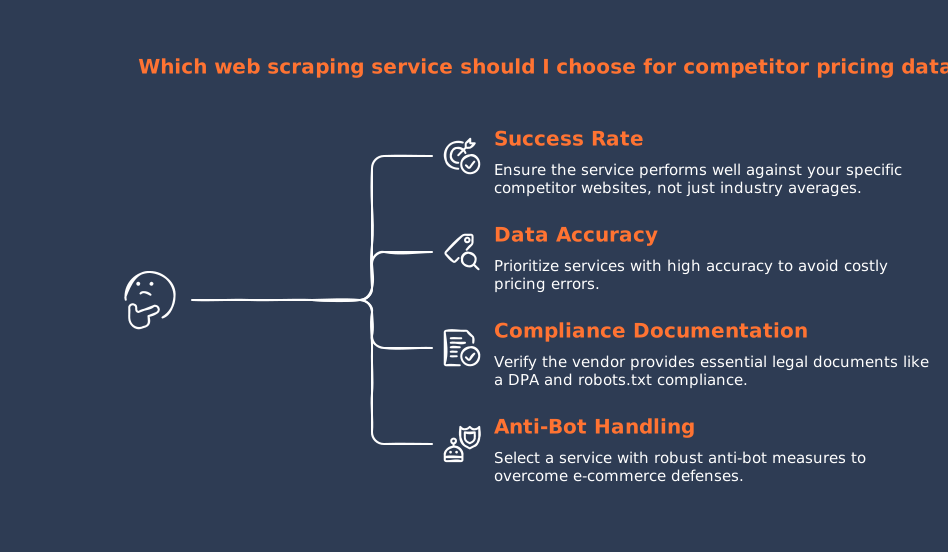
Success Rate Against Your Actual Targets
Every vendor boasts impressive aggregate numbers - 99.99% uptime, 98% extraction accuracy. Looks wonderful on a slide deck. Means almost nothing in practice unless those figures hold up against your specific competitor websites. A cloud-based web scraper that breezes through news aggregators might fall flat against a well-defended Shopify store running aggressive bot detection.
Demand benchmarks against your specific target URLs. Ignore industry averages and typical metrics. Accept only performance rooted in your realities.
Data Accuracy (Not Just Data Volume)
When it comes to pricing intelligence, accuracy isn't a nice-to-have. It's the whole point. Run the maths: a 5% error rate across 10,000 competitor prices gives you 500 wrong data points feeding your pricing decisions. That's not a minor inconvenience - it's a margin evaporating in real time.
Better web crawling services reach above 99% accuracy. They layer AI-driven extraction with human quality checks. Cheaper tools usually land between 85% and 95%. It's worth knowing which group your budget buys before you commit.
Compliance Documentation
This is now non-negotiable in any serious procurement process. Your vendor must deliver all of the following effortlessly:
- A GDPR-compliant Data Processing Agreement (DPA)
- Documented robots.txt compliance procedures
- Audit trails showing data source, collection timestamp, and retention schedule
- PII detection and masking capabilities
- Legal review processes for each domain being scraped
Can't get these within 48 hours of asking? Walk away. Seriously.
Anti-Bot Handling
E-commerce sites have grown remarkably sophisticated at blocking scrapers. Fingerprinting, rotating CAPTCHA, and behavioural analysis - the arms race is real. Put it to vendors bluntly: "What's your current success rate against Amazon, Zalando, and [insert your top competitor here]?" If the answer dips below 95%, their infrastructure isn't robust enough for dependable price monitoring.
Which Web Scraping Services Should You Consider?
We have sorted the top providers into three tiers. These tiers reflect compliance maturity, technical skill, and their service to European businesses.
Fast Fact: The global web scraping market reached approximately €950 million in 2025 and is projected to grow to €1.08 billion this year, reflecting a 13.8% CAGR - driven largely by e-commerce pricing intelligence use cases.
Tier 1: Enterprise-Grade, Compliance-First
| Provider | HQ / Presence | Best For | Starting Price | Key Strength |
|---|---|---|---|---|
| Zyte (formerly Scrapinghub) | London, UK | Audit-ready enterprise pipelines | ~€500/month | 15+ years heritage; EWDCI founding member; built-in GDPR compliance monitoring |
| Bright Data | Global (UK/EU presence) | Large-scale retail price scraping | ~€1.40/1K records | 150M+ proxy IPs; 120+ pre-built retail scrapers; 99.99% uptime |
| GroupBWT | Gdańsk, Poland | Bespoke compliance-first solutions | ~€1,000/month (custom) | Deep GDPR expertise; processed 20M+ Amazon reviews with full compliance documentation |
Zyte stands out for regulatory defensibility, offering managed delivery that blends AI and human review for over 99% accuracy. Its legal team and EWDCI membership highlight a strong level of compliance maturity.
Bright Data operates the largest proxy network - over 150 million IPs - and uniquely charges per record, not per gigabyte, avoiding bandwidth surprises. It offers 120+ pre-built scrapers for Amazon, Google Shopping, and key European marketplaces, with zero setup required. Looking for scale? This is the top option.
GroupBWT serves organizations with complex compliance needs. This includes regulated sectors, multi-jurisdiction operations, or cases where standard solutions do not work. They have processed millions of products across Amazon and Walmart with complete audit documentation. Be ready for a formal procurement process. This is not a tool you set up over lunch.
Tier 2: Mid-Market with Strong European Roots
| Provider | HQ / Presence | Best For | Starting Price | Key Strength |
|---|---|---|---|---|
| Oxylabs | Lithuania | High-speed enterprise proxy infrastructure | ~€49/month | 100M+ IPs; 0.6s response times; 99.95% success rate |
| Apify | Czech Republic | Developer teams wanting flexibility | Free tier available; paid from ~€49/month | 3,000+ pre-built scrapers; community marketplace; excellent documentation |
| ScraperAPI | Global (UK pricing support) | SMBs testing web scraping for the first time | ~€44/month | Transparent credit-based pricing; 7-day money-back guarantee; automatic CAPTCHA handling |
Oxylabs hails from Vilnius and edges out Bright Data on raw response speed - 0.6 seconds on average. Their Web Scraper API bundles proxy management, saving engineering time. One caveat: bandwidth-based billing can spring cost surprises when volumes spike. Best suited to teams who already know their way around proxy infrastructure and don't mind managing it hands-on.
Apify is Czech-born and built squarely for developers. Think of it as a cloud-based web scraper with an app store - over 3,000 community-built "actors" (their word for individual scrapers) cover just about every use case imaginable. The free tier is genuinely useful for kicking the tyres. The downside? Compute-unit pricing gets slippery at scale, and community scrapers vary wildly in reliability.
ScraperAPI wins on sheer simplicity. Credit-based pricing you can actually predict, automatic geo-targeting, a seven-day refund window - it's built for smaller stores taking their first proper run at web data extraction. Don't expect deep compliance infrastructure, though. For heavily regulated sectors, you'll want something beefier.
Tier 3: Specialist Providers Worth Knowing
Datahut operates from Europe and zeroes in on e-commerce data extraction using a hybrid AI-plus-human validation approach. Project-based pricing kicks off at around €40 per website - remarkably affordable given the accuracy on offer. G2 reviewers regularly cite revenue bumps of 10–25% within the first six months, which is the kind of ROI that gets finance teams to stop asking questions.
PromptCloud is headquartered in India but serves a substantial EU client roster. Their sweet spot is fully managed web crawling services paired with unusually thorough compliance documentation - the kind that sails through enterprise procurement audits without drama. They hold a 4.5/5 on Capterra, and custom pricing begins near €1,000/month.
How Much Do Web Scraping Services Cost?
The honest answer: it depends enormously on whether you want a self-service web scraping SaaS tool or a white-glove managed operation. Here's a realistic snapshot of what the market charges right now:
| Tier | Monthly Cost | What You Get | Best For |
|---|---|---|---|
| Budget / Self-Service | €29–€49 | Raw data, minimal validation, basic API access | Developers testing ideas; very small stores |
| Mid-Market / Managed | €200–€500 | Managed infrastructure, basic compliance docs, structured data delivery | Growing e-commerce businesses |
| Enterprise | €500–€2,500+ | Compliance SLAs, human oversight, audit-ready governance, dedicated support | Regulated industries; large retailers |
One thing to flag: if somebody pitches enterprise-level price monitoring at under €200 a month, something is missing. Compliance shortcuts, threadbare data validation, dodgy proxy sourcing - the discount comes from somewhere. And with GDPR enforcement now running comfortably north of a billion euros annually, trimming €300/month off your scraping bill is the definition of a false economy.
Fast Fact: 85% of e-commerce businesses now track rival pricing through automated tools, and by the end of 2026, over 70% of European retailers are expected to operate with some form of real-time pricing automation.
Red Flags: When to Walk Away from a Vendor
Not every provider in this space deserves your trust - or your data. Keep your guard up for these signals:
- No published compliance credentials. If a vendor claims "public data is always legal" without nuance, they fundamentally misunderstand the 2026 regulatory landscape. Next.
- Vague "proprietary methods" for bypassing detection. Reputable services disclose their proxy sourcing (residential, datacenter, mobile) and rotation strategies. Opacity here often means they're violating terms of service - or worse.
- No SLA or uptime guarantees. Enterprise-grade services explicitly state uptime percentages (typically 99.9%+), incident response times, and service credits. No SLA means they're not positioned for business-critical applications.
- No data retention policy. If they can't tell you how long they store your extracted data and when it gets deleted, they're not GDPR-ready.
- Suspiciously low pricing. Below €200/month for managed price monitoring? Ask hard questions about what's missing.
Six Questions to Ask Before You Sign
- "Can you provide a GDPR Article 28 Data Processing Agreement?" - This reveals whether they treat data protection as a contractual obligation or an afterthought.
- "Walk me through your legal review process for a new domain." - Mature vendors have documented procedures. Expect 5–10 business days for domain review covering robots.txt, terms of service, and anti-circumvention checks.
- "What's your success rate against [your three most important competitors]?" - Generic benchmarks are meaningless. Demand performance data against your targets.
- "How do you handle data drift - layout changes, pricing format variations, regional differences?" - This reveals whether they use brittle CSS selectors or AI-powered extraction that adapts automatically.
- "Show me a sample audit trail." - You want to see the data source, collection timestamp, retention schedule, and deletion proof. If they can't demonstrate this, they're not compliance-ready.
- "What happens if a website sends a cease-and-desist?" - The answer tells you everything about their confidence in their legal posture and how contractual risk is allocated.
Where Flexi IT Fits In
We should be upfront: Flexi IT doesn't sell web scraping as a standalone product. That's not our lane. What we actually do - and do well - is help European businesses stitch pricing intelligence into the rest of their web infrastructure. Connecting a scraping service to your e-commerce platform. Building bespoke dashboards that make the data useful. Automating the entire pipeline so raw competitor numbers become real pricing decisions without anyone copying and pasting a spreadsheet at midnight.
Already picked a web scraping service but struggling to wire it into your WordPress or WooCommerce store? Need a custom comparison interface or an automated repricing workflow? That's exactly the sort of problem we solve, day in, day out, for clients across Europe. We take raw web data extraction and turn it into something your business can actually act on - minus the compliance migraines.
Drop our team a line if you'd like to talk through how competitor pricing data could slot into what you're already running.
Key Terms
| Term | Definition |
|---|---|
| Web Scraping | Automated extraction of data from websites using bots or scripts |
| robots.txt | A file on websites that tells crawlers which pages they may or may not access |
| DPA (Data Processing Agreement) | A GDPR-required contract between a data controller and processor outlining data handling responsibilities |
| PII (Personally Identifiable Information) | Any data that could identify a specific individual - names, emails, IP addresses, etc. |
| Anti-Bot / CAPTCHA | Technologies deployed by websites to detect and block automated scraping activity |
| Data Drift | When website layout or data format changes break existing scraping configurations |
| SLA (Service Level Agreement) | A contractual commitment specifying uptime, response times, and remedies for service failures |
Summary for Busy Decision-Makers
- Scraping competitor prices is legal in Europe when targeting publicly available data, respecting robots.txt, and maintaining GDPR compliance documentation.
- The regulatory bar is rising. The EU AI Act (August 2026), updated UK data legislation (February 2026), and recent court rulings mean compliance is no longer optional.
- Top-tier providers for European businesses include Zyte (compliance-first), Bright Data (scale), and Oxylabs (speed). Mid-market options like Apify and ScraperAPI suit smaller budgets.
- Budget realistically: €200–€500/month for managed mid-market services; €500–€2,500+ for enterprise-grade with compliance SLAs.
- Always demand a DPA, domain-specific success rates, and a sample audit trail before signing.
- Accuracy matters more than volume. A 5% error rate across thousands of products translates directly into lost margin.
- Need help integrating pricing data into your store? Flexi IT specialises in connecting web scraping services to e-commerce platforms across Europe.


