
Need a web development studio to overhaul your business website? Good. You're asking the right question. Start with verified directories like Clutch.co and DesignRush - they vet agencies through proper client interviews and portfolio scrutiny, not just self-submitted blurbs. Focus on studios with case studies proving conversion improvements, not just impressive visuals. Teams like Flexi IT combine UX research and conversion-driven development, prioritising measurable results over cosmetic changes. Key takeaway: Choose studios with a proven record of boosting conversions, not just aesthetics.
Here's what we'll cover:
- Why UX-driven redesigns deliver serio us ROI in 2026
- Where to find the best web design companies across Europe
- What separates top website design companies from mediocre ones
- Red flags that signal trouble ahead
- Realistic budget expectations for lead generation-focused projects
Why UX and Lead Generation Should Drive Your Redesign
Pretty websites that don't convert? They're just expensive wallpaper. Businesses are realising this difference matters. The global web development market topped roughly €75 billion last year and keeps climbing at 9.3% annually - most of that growth comes from organisations investing in conversion-centric redesigns, not just looks. Key takeaway: The market shift is toward websites that generate results, not just appearance.
Fast Fact: Quality UX design can increase conversion rates by up to 400%, with ROI potentially reaching 9,900% - roughly €100 return for every €1 invested.
Not fantasy. These figures reflect what happens when a website stops acting as a passive brochure and starts steering visitors toward action. Form fills. Demo bookings. Purchases. Whatever metric matters to your bottom line, thoughtful UX moves it.
The evidence stacks up quickly. Organisations that invest properly in UX optimisation see 7-25% increases in conversion rates within 6 months of launch. E-commerce sites? Mobile conversion rates typically range from 15% to 40%. Simple maths: if your current site converts at 2% and you push it to 3%, you've just grown revenue by half - same traffic, no extra ad spend.
Where to Find Qualified Web Development Studios
Verified Agency Directories
Clutch.co is the benchmark for sourcing the best website development agencies. Their verification is not superficial. They conduct in-depth client interviews, review portfolios, and assess market presence. Filters let you sort by capability, budget, geography, and sector. Top-ranked studios have 4.5+ star ratings and verified reviews. These are not cherry-picked testimonials; they are actual feedback.
DesignRush takes a different angle. They rank providers on five criteria: portfolio quality, client reviews, industry gongs, years trading, and team credentials. Roughly 1,200 verified agencies are listed in their global directory; European studios make up about 35% of that pool.
GoodFirms shines when you're hunting mid-market agencies in specific regions. Want a studio in Germany with healthcare experience? Their filtering handles that nicely.
Direct Research and Portfolio Review
Directories give you a shortlist. That's it. Direct research separates real contenders from polished pretenders. When sizing up any web development studio, dig into their case studies. "Increased form submissions by 45%" means something. "Significantly improved conversions" means nothing. Key takeaway: Evaluate agencies by tangible metrics, not vague claims. Try this: scrutinise the agency's website. Is it responsive? Does it load quickly? Are the calls-to-action obvious? If they can't follow their own advice, why trust them with your site? At Flexi IT, we treat our homepage as a live proof-of-concept. If we can't optimise our own conversion paths, we shouldn't optimise anyone else's.
Professional Networks and Referrals
Referrals are underrated. Ask peers - especially those who recently finished site redesigns in your sector - about their experience. Direct conversations reveal communication habits, project discipline, and how an agency reacts when things go wrong. That kind of intel almost never shows up in formal reviews.
What Makes the Best Web Design Companies Stand Out
Cross-Functional Teams
Strong studios field cross-functional squads: UX researchers, conversion specialists, frontend engineers, backend architects, and project managers - all working together. This isn't about headcount for its own sake. It's about capability. A design-only shop will struggle with complex integrations. A dev-only shop might build something technically great that doesn't convert. Ask directly: Who will work on my project? What is their background? What if someone leaves during the build? Vague answers can signal staffing gaps or the unexpected assignment of juniors to your project.
Documented Processes
The best web design and development companies use documented workflows: discovery, design, build, test, launch. This is not red tape. It's discipline. Formal change management protects everyone from scope creep and missed deadlines. Ask to see documentation before you sign. Agencies that are reluctant to share their methodology might be improvising. That's fine for comedy, but risky for your business site.
Lead Generation Expertise
If leads matter, make sure conversion rate optimisation is central to their service - not an afterthought. Look for:
- Case studies with specific lead generation metrics
- Experience with CRM integrations (HubSpot, Salesforce, Pipedrive)
- A/B testing capabilities and analytics interpretation skills
- Understanding of behaviour-driven design principles
We've watched businesses sink €30,000 into redesigns that dazzle visually yet generate fewer enquiries than before. Design without a conversion strategy? That's just decoration.
Red Flags When Evaluating Studios
Some warning signs should kill a conversation immediately:
| Red Flag | What It Signals |
|---|---|
| No professional portfolio or outdated work samples | Lack of capability or inadequate self-presentation |
| Unwilling to provide client references | Unsatisfactory work or insufficient client relationships |
| Cookie-cutter template approach (sites look nearly identical) | Insufficient investment in client-specific solutions |
| Aggressive sales tactics or pressure to sign quickly | Desperation or predatory practices |
| Poor communication during evaluation phase | Communication problems will worsen during delivery |
| Vague pricing with hidden costs | Budget overruns likely |
Notice patterns on Clutch and GoodFirms. One negative review could be a difficult client. Several complaints about ghosting, blown deadlines, or scope bloat? That's a sign of bigger problems. Walk away.
What Should a UX-Focused Redesign Cost in 2026?
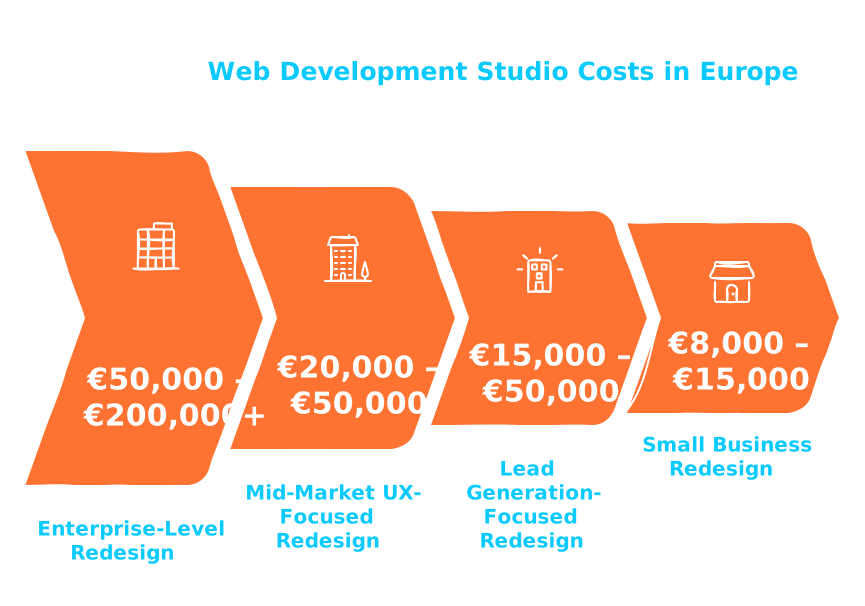
Costs swing widely depending on region and scope. Here's what European businesses usually pay:
| Project Type | Western Europe | Eastern Europe |
|---|---|---|
| Small business redesign | €8,000 – €15,000 | €2,000 – €8,000 |
| Mid-market UX-focused redesign | €20,000 – €50,000 | €12,000 – €35,000 |
| Lead generation-focused redesign | €15,000 – €50,000 | €10,000 – €30,000 |
| Enterprise-level redesign | €50,000 – €200,000+ | €40,000 – €120,000 |
Fast Fact: Eastern European agencies typically operate at €30-60 per hour, representing a 50-70% cost reduction compared to Western European alternatives while maintaining strong technical standards.
We sit in that sweet spot. Flexi IT is based in Ukraine and serves UK and European clients. You get Western European quality without the London or Berlin invoice. Conversion-focused work at sensible rates - that's the proposition.
Hidden Costs to Budget For
Don't stop at the quoted build fee. Factor these in:
- Hosting: €50-200 monthly for quality managed hosting
- Ongoing maintenance: €100-500 monthly
- Content updates and optimisation: €100-500 per update
- Analytics and tracking tools: €0-200 monthly
That €20,000 redesign? It often balloons to €25,000+ across year one when you tally everything. Build in 10-20% contingency. You'll thank yourself later.
Key Terms Glossary
- UX (User Experience)
- How visitors interact with and feel about your website. Good UX removes friction and guides users toward desired actions.
- CRO (Conversion Rate Optimisation)
- Systematic improvement of website elements to increase the percentage of visitors who complete desired actions.
- Lead Generation
- The process of attracting and converting website visitors into potential customers who've expressed interest in your services.
- A/B Testing
- Comparing two versions of a webpage to determine which performs better for a specific conversion goal.
- CRM Integration
- Connecting your website forms and tracking to Customer Relationship Management software like HubSpot or Salesforce.
Summary: What Busy Decision-Makers Need to Know
- Start with verified directories (Clutch.co, DesignRush) to find vetted web development studios
- Demand specific metrics in case studies - "improved conversions" isn't evidence
- Verify cross-functional capability - UX research, development, and CRO expertise under one roof
- Check the agency's own website as a live demonstration of their standards
- Budget €15,000-50,000 for a mid-market UX and lead generation-focused redesign
- Consider Eastern European studios for 50-70% cost savings without quality compromise
- Expect 7-25% conversion improvements within six months from quality UX investment
Ready to Discuss Your Redesign?
Finding the right web development studio takes legwork. Worth it, though. A website that actually pulls in leads - rather than just looking professional - pays for itself many times over. If you're weighing options and want a straight conversation about what's achievable for your budget, let's talk.
Flexi IT specialises in conversion-focused redesigns for European businesses. No waffle. No inflated promises. Just practical builds backed by numbers you can verify. Get in touch and let's see what makes sense for your project.


